# Why Expected Cut-offs Change as New Data Arrives
How Expected Cut-off Ranges Work and How Candidates Should Use Them
English Version
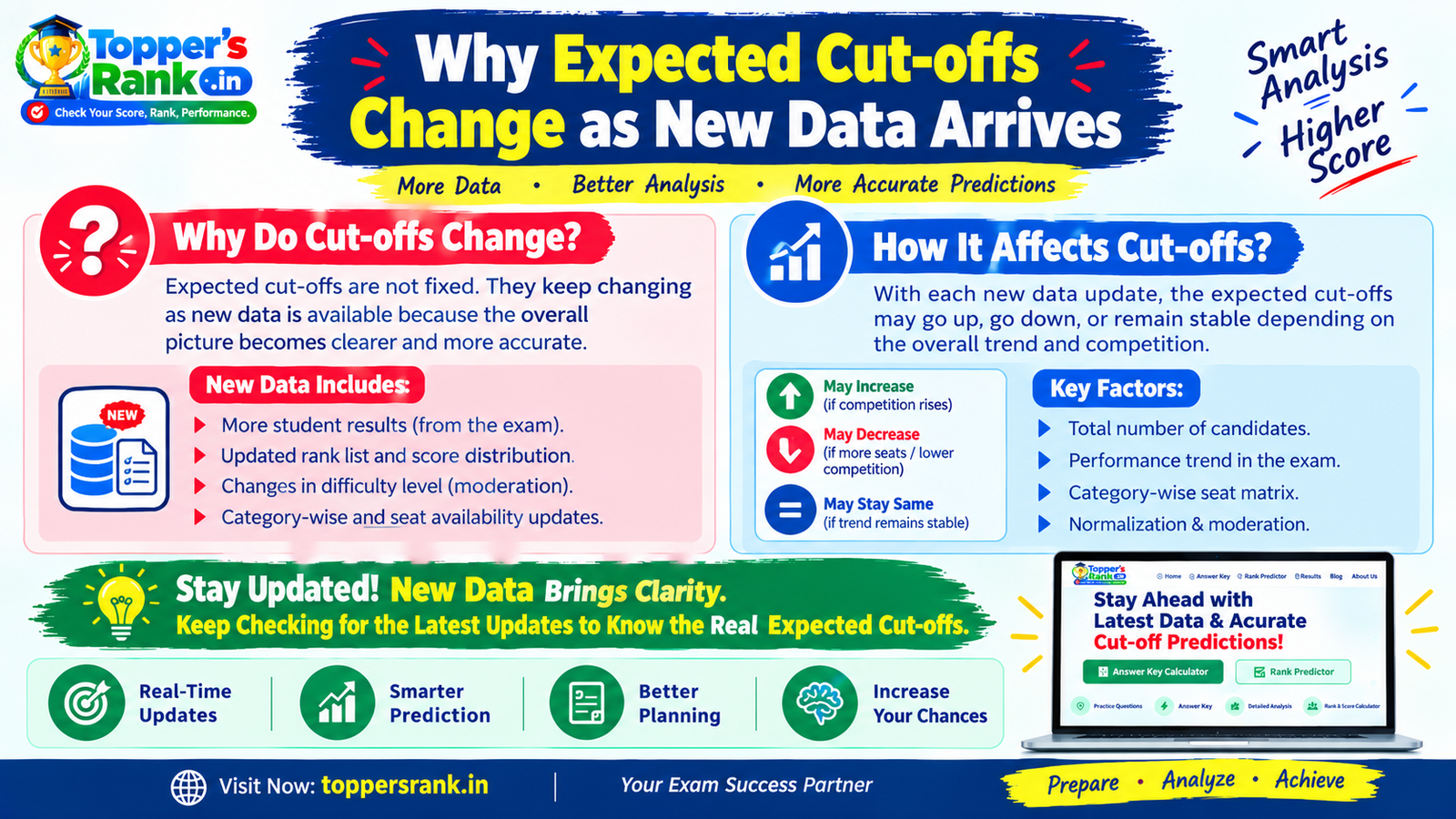
An expected cut-off is a dated estimate, not an official or authoritative result. It is generally prepared using the information available at a particular point in time, such as candidate responses, answer keys, exam difficulty, score trends, previous-year cut-offs, candidate performance, and available seat or vacancy information.
As more reliable data becomes available, the estimated cut-off may change. A cut-off published immediately after an examination may therefore look different from one published after more candidates have shared their scores or after additional exam-related information becomes available.
Why Does the Expected Cut-off Change?
Expected cut-offs are based on incomplete information. Early estimates may be calculated from a relatively small sample of candidates. When additional data arrives, the underlying analysis can become broader and more representative.
Several factors can influence an expected cut-off:
- More candidate responses: Additional score and response data can change the observed score distribution.
- Answer-key updates: A provisional or revised answer key can affect calculated scores.
- Exam difficulty: Analysis of the paper can provide a better understanding of how candidates performed.
- Score distribution: The number of candidates around different score ranges can affect the estimated boundary.
- Number of candidates: A larger or smaller candidate pool can influence competition.
- Seats and vacancies: Available seats, vacancies, and category-wise allocation may affect the eventual qualifying boundary.
- Normalization or moderation: In examinations conducted across multiple shifts, applicable normalization or moderation methods can affect scores.
- Category-wise trends: Expected cut-offs can differ across categories depending on the examination rules and available seats.
Why Is There Sometimes No Expected Cut-off?
Publishing an expected cut-off too early can create a misleading impression of accuracy. If only a small amount of reliable data is available, there may not be enough evidence to establish a meaningful range.
In such situations, it can be more responsible to wait for additional information rather than present a precise-looking number based on limited observations.
For example, an early estimate based on a small group of candidates may change considerably once responses from a much larger group become available.
Why a Range Can Be More Useful Than a Single Number
An expected cut-off should generally be understood as an estimate with uncertainty, rather than a guaranteed threshold.
For example:
Expected Cut-off Range: 72–78 marks
This does not mean that 78 marks is an official cut-off or that 72 marks guarantees qualification. It simply communicates that, based on the available information at that time, the estimated boundary may fall somewhere within that range.
A range also makes it easier for candidates to understand the uncertainty involved in early prediction.
How Candidates Should Use an Expected Cut-off
Candidates can use an expected cut-off as one input for planning, but should avoid treating it as the final result.
A practical approach is to:
- Check the date of the estimate. Older estimates may be based on less data.
- Look at the methodology. Understand which factors were considered.
- Consider the range, not only the midpoint.
- Check for later updates when additional data becomes available.
- Compare the estimate with the official notification or result once the authority publishes it.
- Avoid making important decisions solely on an unofficial estimate.
Expected Cut-off vs Official Cut-off
These two terms should not be confused.
| Expected Cut-off | Official Cut-off | | ------------------------------------- | -------------------------------------------------------------------- | | An estimate | An officially published result | | Based on available data and analysis | Determined and published by the examination authority | | Can change as new information arrives | Becomes authoritative when officially released | | May be presented as a range | May be published as specific marks, ranks, or category-wise criteria | | Useful for preliminary planning | Used for official qualification or admission decisions |
Final Takeaway
An expected cut-off is a snapshot of an estimate based on the data available on a particular date. As new candidate responses, score information, answer-key updates, examination analysis, seat information, and other relevant data become available, the estimate can move.
The most responsible way to use an expected cut-off is to treat it as an informational range rather than a guaranteed result. Candidates should keep checking for updated analysis and ultimately rely on the official result and cut-off published by the relevant examination authority.
---
# नई जानकारी आने पर Expected Cut-off क्यों बदलता है?
Expected Cut-off Range को कैसे समझें और उम्मीदवार इसका सही उपयोग कैसे करें
हिंदी संस्करण
Expected Cut-off क्यों बदलता है?
Expected Cut-off को प्रभावित करने वाले प्रमुख कारक हैं:
धिक उम्मीदवारों का डेटा:** नए Score और Response मिलने से Score Distribution की तस्वीर बदल सकती है।
- Answer Key में बदलाव: Provisional या Revised Answer Key के कारण Calculated Score बदल सकता है।
- परीक्षा का कठिनाई स्तर: Paper Analysis से उम्मीदवारों के प्रदर्शन को बेहतर तरीके से समझा जा सकता है।
नुमान को प्रभावित कर सकता है।
- Seats और Vacancies: उपलब्ध सीटें, रिक्तियां और Category-wise Seat Allocation महत्वपूर्ण हो सकते हैं।
कभी-कभी Expected Cut-off क्यों नहीं दिया जाता?
Single Number की जगह Range क्यों उपयोगी है?
उदाहरण:
Expected Cut-off Range: 72–78 Marks
उम्मीदवार Expected Cut-off का उपयोग कैसे करें?
Expected Cut-off को Planning के लिए एक महत्वपूर्ण Input की तरह देखा जा सकता है, लेकिन इसे Final Result नहीं मानना चाहिए।
उम्मीदवार इन बातों का ध्यान रख सकते हैं:
नुमान कम डेटा पर आधारित हो सकता है।
नुमान किन Factors के आधार पर बनाया गया है।
- केवल एक Number पर निर्भर न रहें। पूरी Expected Range को देखें।
नुमान बदल सकता है।
- Official Notification और Result से तुलना करें।
- केवल Unofficial Estimate के आधार पर महत्वपूर्ण निर्णय न लें।
ंतर
दोनों को एक जैसा नहीं समझना चाहिए।
 Exam Guidance · 16 minHow To Save And Use Your Score Card Safely
 Exam Guidance · 18 minRRB ALP CBT-2 Score Analysis: Part A, Part B and Merit
 Exam Guidance · 10 minHow Vacancy Data Affects Expected Cut-off