
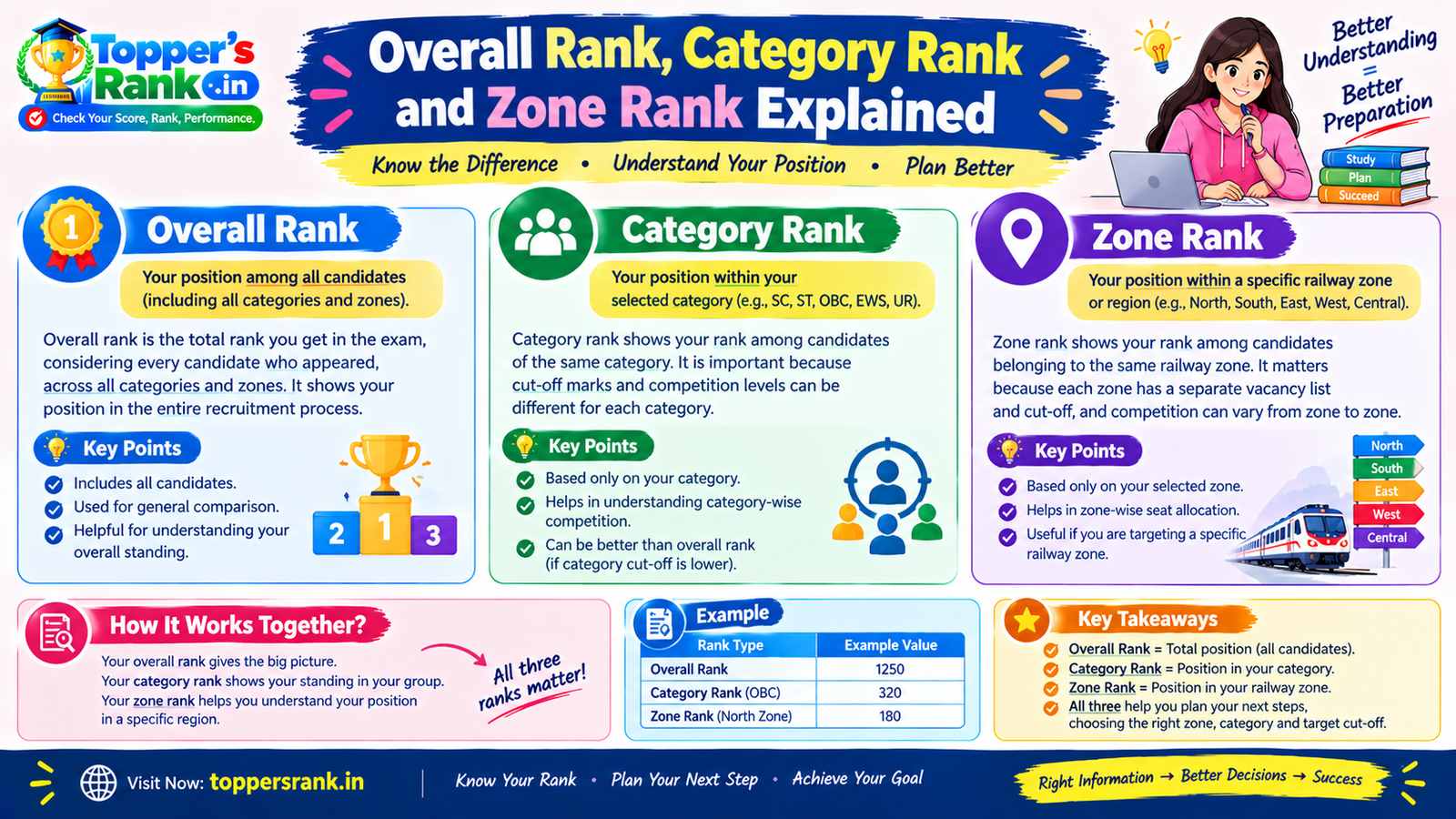
# Overall Rank, Category Rank and Zone Rank Explained
Understanding your rank is more than looking at a single number. Depending on the examination and recruitment rules, a candidate may have an Overall Rank, Category Rank, Zone Rank, Zone + Category Rank, or Post-wise Rank. Each rank answers a different question about where the candidate stands within a particular comparison group.
For meaningful analysis, candidates should first understand which candidate group is being compared and which vacancy structure applies to that recruitment.
---
1. What Is Overall Rank?
Overall Rank represents a candidate's position when compared with the candidates included in the selected examination dataset, without applying a category, zone, or post-specific filter.
For example, if a candidate's Overall Rank is 1,250, it means the candidate is positioned at rank 1,250 within the population covered by that calculation.
However, Overall Rank does not automatically mean final selection rank.
An examination may use separate:
- Category-wise vacancies
- Zone-wise vacancies
- Post-wise vacancies
- Railway/unit-wise vacancies
- Reservation rules
- Eligibility conditions
- Preference and allocation rules
Therefore, an Overall Rank can be useful for understanding the broad competitive position, but it should not be treated as a guaranteed representation of the final merit list unless the official recruitment rules use the same ranking basis.
Example
Suppose 100,000 candidates are included in a calculation and a candidate has:
Overall Rank = 4,500
This indicates the candidate's position within that analysed population. It does not by itself establish whether the candidate will qualify for a particular post, category or zone.
---
# 2. What Is Category Rank?
Category Rank compares a candidate with other candidates belonging to the same applicable category.
Common categories may include:
- UR
- OBC
- EWS
- SC
- ST
The exact categories depend on the recruitment notification.
Category Rank can provide a more specific view of competition because the number of vacancies and qualifying criteria may differ across categories.
Example
A candidate could have:
Overall Rank = 4,500 OBC Rank = 620
These two numbers are measuring different comparison groups. The Overall Rank considers the broader candidate population, while the OBC Rank considers the candidates included in the OBC group for that analysis.
Why Category Rank Matters
Category-wise analysis can be particularly useful when the recruitment has category-specific vacancy allocation or qualifying criteria.
However, the category used for ranking must match the applicable recruitment information.
Important Check
Candidates should verify that their category shown in the response sheet, application record, or relevant official data matches the category selected in the calculator.
An incorrect category selection can produce a misleading category rank.
---
# 3. What Is Zone Rank?
A Zone Rank applies when a recruitment process is divided into specific railway zones, regions, boards, states, or other defined recruitment units.
In such a system, instead of comparing a candidate with everyone in the complete dataset, the calculation may compare the candidate only with candidates associated with the selected zone.
For example:
Overall Rank = 4,500 North Zone Rank = 480
The two ranks represent different comparison populations.
Why Zone Rank Can Matter
If vacancies are distributed zone-wise, the relevant competition for a candidate may depend partly on the candidate's selected or applicable zone.
Zone-level analysis can therefore help candidates understand the competitive environment within a particular recruitment unit.
However, the exact significance of a zone depends on the official recruitment rules.
---
# 4. What Is Zone + Category Rank?
Sometimes the most useful comparison is created by applying both the zone and category filters.
For example:
Zone = North Category = OBC
The resulting figure represents the candidate's position among the candidates who fall within that combined group in the analysed dataset.
This can be described as:
Zone + Category Rank
Why This Can Be More Specific
Consider a recruitment where vacancies are distributed by both zone and category.
A candidate may therefore be competing within a group defined by:
Selected Zone + Applicable Category
A zone-wise overall rank may include candidates from multiple categories, while a category rank may include candidates from multiple zones. A combined rank can provide a narrower comparison group when the recruitment structure supports both filters.
---
# 5. What Is Post-Wise Rank?
Some recruitment processes divide vacancies by post as well as category, zone, railway or unit.
In such cases, simply looking at Overall Rank or Category Rank may not be enough.
A more detailed analysis may require:
Post + Zone + Category
or another combination specified by the recruitment rules.
For example, suppose a recruitment includes several posts:
- Technician
- Clerk
- Assistant
- Operator
A candidate's relevant competitive group may depend on the post for which they are eligible or being considered.
Therefore, the same score can have different practical implications under different post-wise vacancy structures.
---
# 6. Why the Ranking Basis Matters
The same candidate can have several different ranks without any contradiction.
For example:
| Rank Type | Example | | --------------------------- | ------: | | Overall Rank | 4,500 | | Category Rank | 620 | | Zone Rank | 480 | | Zone + Category Rank | 95 | | Post + Zone + Category Rank | 32 |
Each number is based on a different comparison group.
The important question is not simply:
“What is my rank?”
It is:
“Rank among which candidates, using which filters and which vacancy structure?”
That is the key to interpreting rank data correctly.
---
# 7. How a Rank Calculator Should Present the Basis
A good result checker or rank-prediction system should clearly identify the basis used for every rank.
For example:
Overall Rank: Based on all candidates included in the selected exam dataset.
Category Rank: Based on candidates in the selected category.
Zone Rank: Based on candidates in the selected zone.
Zone + Category Rank: Based on candidates matching both the selected zone and category.
Post Rank: Based on candidates considered for the selected post.
Post + Zone + Category Rank: Based on all three relevant filters.
This transparency helps candidates understand what each number actually represents.
---
# 8. Response Sheet Category Must Match the Calculator
One of the most important practical checks is category consistency.
Suppose the response sheet identifies a candidate as EWS, but the calculator is manually set to OBC.
The resulting category rank may not represent the candidate's actual comparison group.
Before calculating a category-specific rank, candidates should therefore verify:
Candidate Category → Application/Response Data → Calculator Category
These should be consistent with the applicable recruitment rules.
---
# 9. Overall Rank Does Not Always Equal Selection Rank
A common misunderstanding is:
“My Overall Rank is within the number of total vacancies, so my selection is guaranteed.”
That conclusion may not be valid.
Selection can depend on factors such as:
- Category
- Zone
- Post
- Railway/unit
- Eligibility
- Medical standards
- Vacancy distribution
- Candidate preferences
- Tie-breaking rules
- Recruitment-specific allocation rules
Therefore, rank analysis should be treated as a way to understand competitive position rather than as an automatic confirmation of final selection.
The final selection outcome depends on the official recruitment process.
---
# 10. Why Vacancy Structure Should Be Considered Alongside Rank
Rank becomes more meaningful when interpreted together with the relevant vacancy structure.
For example, consider:
Category: OBC Zone: Zone A Post: Post X Relevant Vacancy: 120 Zone + Category Rank: 85
This information may provide more context than simply reporting:
Overall Rank: 4,500
However, even a detailed rank does not guarantee selection because the actual recruitment rules and final allocation process may involve additional conditions.
---
# 11. Sample-Based Ranks Have Additional Limitations
If a rank is calculated from voluntarily submitted candidate data rather than complete official candidate data, it should be described as a sample-based or estimated rank.
For example:
“Estimated Zone + Category Rank based on submitted candidate responses.”
This is different from an official rank published by the examination authority.
A voluntary dataset may not include:
- Every candidate
- Every category equally
- Every zone equally
- Every score range proportionally
Some candidates may also submit incorrect or incomplete information.
Therefore, sample-based rank figures should be interpreted with appropriate caution.
---
# 12. How Candidates Should Read Their Rank Report
A useful rank report should answer five questions:
Who is being compared?
All candidates, category candidates, zone candidates, or a specific post group?
Which filters are applied?
Category, zone, post, or a combination?
What is the data source?
Official candidate data, verified data, or voluntary submissions?
What vacancies are relevant?
Overall vacancies or the vacancies applicable to the specific category, zone, and post?
Is the rank official or estimated?
This distinction is essential.
---
# 13. A Simple Ranking Framework
The relationship can be visualized like this:
All Candidates ↓ Category Filter ↓ Zone Filter ↓ Post Filter ↓ Final Relevant Comparison Group
Not every recruitment uses all these filters. The applicable structure depends on the examination notification.
---
# 14. Overall Rank vs Category Rank vs Zone Rank
| Rank Type | Comparison Group | Main Purpose | | --------------------------- | -------------------------------------------- | ------------------------------------- | | Overall Rank | All candidates in the analysed dataset | Understand broad competitive position | | Category Rank | Candidates in the same category | Understand category-wise position | | Zone Rank | Candidates within the selected zone | Understand zone-wise position | | Zone + Category Rank | Candidates within the same zone and category | More specific competition analysis | | Post Rank | Candidates associated with the same post | Post-wise comparison | | Post + Zone + Category Rank | Candidates matching all applicable filters | Detailed merit analysis |
---
# 15. Key Takeaway
Overall Rank gives the broad picture. Category Rank narrows the comparison to a category. Zone Rank narrows it to a recruitment zone. Combining zone, category and post filters can provide an even more specific view when the recruitment structure supports those filters.
The most useful rank is therefore not necessarily the smallest number. Its usefulness depends on whether the comparison group matches the actual vacancy and selection structure of the examination.
Candidates should always check the ranking basis, category, zone, post, vacancy structure and data source before interpreting any rank as an indication of selection.
Ultimately, the official recruitment notification, official merit list and final result remain authoritative for actual qualification and selection.
 Exam Guidance · 16 minHow To Save And Use Your Score Card Safely
 Exam Guidance · 18 minRRB ALP CBT-2 Score Analysis: Part A, Part B and Merit
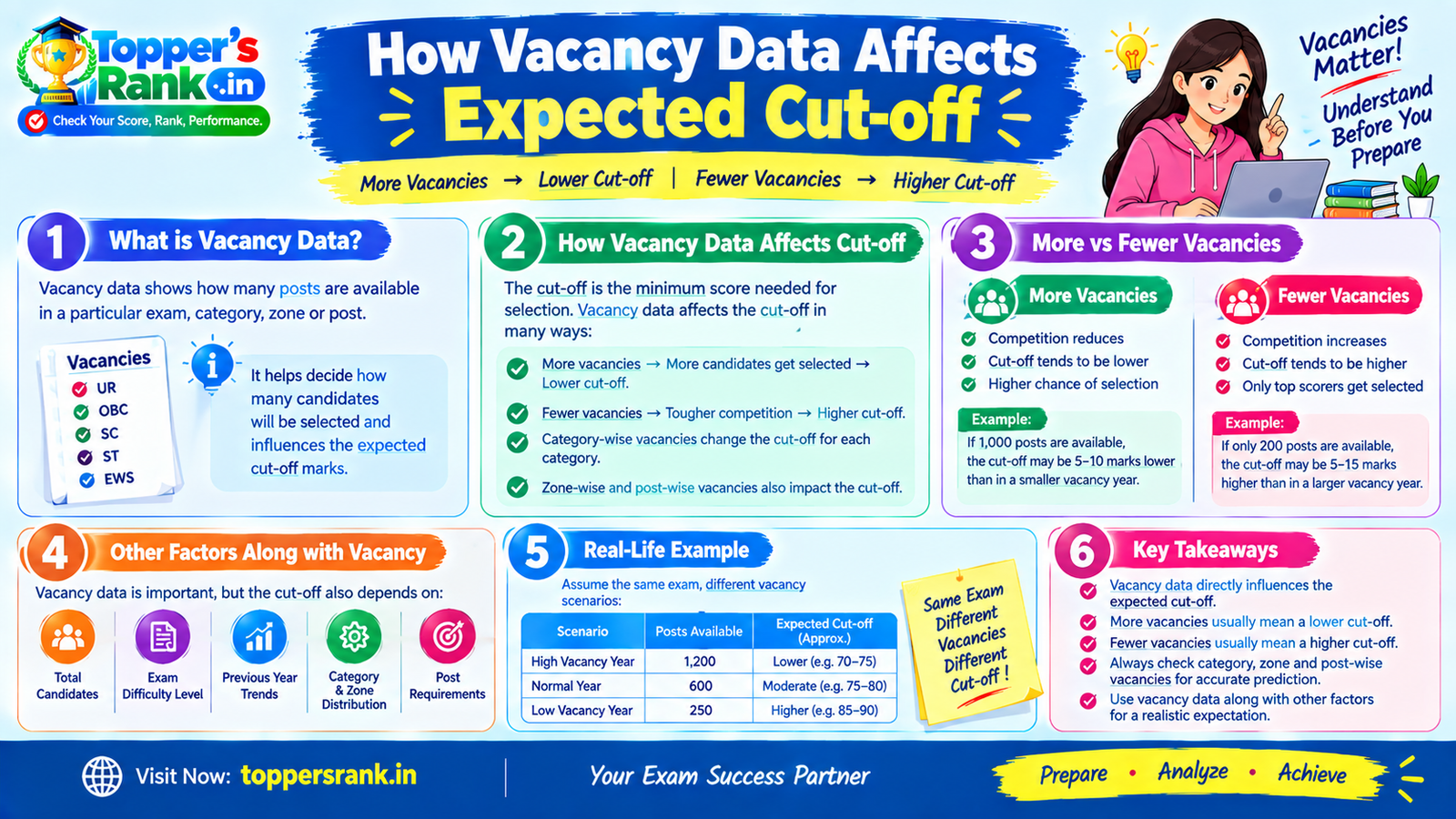 Exam Guidance · 10 minHow Vacancy Data Affects Expected Cut-off