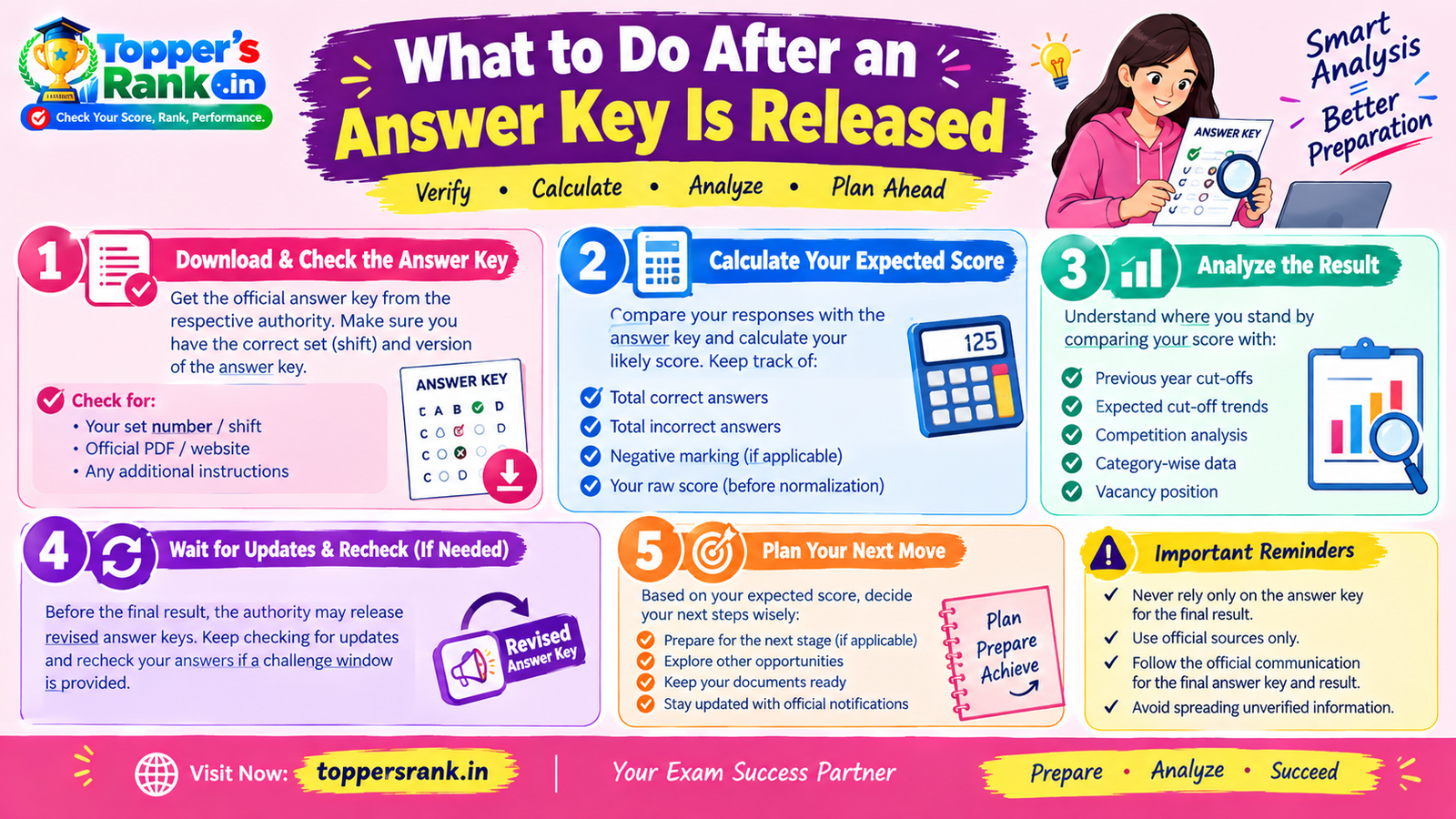
# What to Do After an Answer Key Is Released
When an examination authority releases an answer key or response sheet, it can be tempting to immediately calculate your marks and start comparing scores. However, a better approach is to first secure all important exam records, verify the marking rules, and then calculate your score carefully.
A small mistake in reading the response sheet, applying negative marking, or handling dropped questions can change the estimated score. Following a proper step-by-step process can help you avoid confusion and preserve important documents that may no longer be available later.
1. Save Your Response Sheet and Answer Key First
Before calculating anything, save a copy of the official response sheet and answer key.
Many examination portals make response sheets, candidate login pages, or answer-key links available only for a limited period. Once the objection or answer-key window closes, the link may stop working or the candidate login may no longer show the response sheet.
Whenever possible, save:
- The official response sheet
- Provisional answer key
- Final answer key, when released
- Response-sheet HTML file
- PDF copy or print-to-PDF version
- Official answer-key page or URL
- Question paper, if provided
- Candidate response details
It is also useful to keep your important exam information together, including:
- Roll number
- Registration or application number
- Exam name
- Exam date
- Examination shift
- Subject or paper name
- Post or preference, where applicable
- Category and zone details, where relevant
Keeping these records can be useful later if you need to recalculate your score, compare a provisional answer key with the final answer key, raise an objection, or verify your result.
2. Do Not Assume the Marking Scheme
Before calculating your marks, check the official marking scheme for that specific examination.
Different examinations can follow completely different scoring rules. Even two papers conducted by the same recruitment authority may not use the same positive marks or negative marking formula.
For example, an exam may award:
- 1 mark for every correct answer
- 2 marks for every correct answer
- 0.25 negative marks for a wrong answer
- One-third negative marking
- 0.50 negative marks
- No negative marking at all
Therefore, never calculate marks using a general formula unless you have confirmed that it applies to your paper.
A common calculation may look like:
Estimated Raw Score = Marks for Correct Answers − Negative Marks for Incorrect Answers
However, this formula may need adjustment if the examination includes bonus questions, dropped questions, multiple correct options, sectional scoring, or different marking rules for different parts.
3. Check Section-Wise and Paper-Wise Rules
Many examinations contain more than one section, subject, paper, or stage.
For example, a paper may contain:
- Part A and Part B
- General Awareness and Technical sections
- Language and subject sections
- Qualifying and merit sections
- Paper I and Paper II
Do not automatically assume that marks from every section contribute equally to the final merit.
One section may be qualifying in nature, while another may determine the merit score. Some examinations may also require candidates to achieve a minimum score in each section separately.
Before interpreting your score, verify:
- Whether all sections count toward merit
- Whether any section is qualifying only
- Whether sectional cutoffs apply
- Whether different sections have different marking rules
- Whether there is a minimum qualifying percentage
- Whether marks are combined across papers or stages
This is especially important because a high overall score may not be sufficient if a candidate fails to meet a mandatory sectional or qualifying requirement.
4. Calculate Correct, Wrong and Unattempted Questions
Once the marking scheme is confirmed, count your responses carefully.
Normally, your response analysis should show:
- Total questions
- Attempted questions
- Correct answers
- Incorrect answers
- Unattempted questions
- Dropped or cancelled questions, where applicable
- Bonus questions, where applicable
A useful basic check is:
Correct + Incorrect + Unattempted = Total Valid Questions
If these figures do not match, review the response sheet again before trusting the calculated score.
Candidates should also verify whether an unanswered question is genuinely marked as unattempted rather than being interpreted as an incorrect response.
5. Cross-Check the Calculated Score
After calculating your score, compare the result with the original response sheet.
Do not rely only on the final number shown by a calculator. Review the supporting details as well.
Check whether:
- The total number of attempted questions is correct
- Correct answers are being matched with the correct question IDs
- Wrong answers have the proper negative marks applied
- Unattempted questions are not being penalized
- Dropped questions are handled correctly
- Bonus questions are counted according to the official rule
- Multiple-correct-option questions are evaluated properly
- Section-wise marks are being calculated under the correct scheme
If the calculated score looks unexpectedly high or low, do not immediately assume either the answer key or calculator is wrong. Recheck the source data first.
6. Understand Question IDs and Option IDs
Computer-based examination response sheets often use internal question IDs and option IDs instead of simple question numbers such as Question 1, Question 2, and Question 3.
This can create confusion when comparing your selected answer with the official key.
Make sure you correctly identify:
- Question ID
- Your selected option ID
- Official correct option ID
- Question status
- Whether the question was attempted
- Whether the question was marked for review
- Whether the authority later changed the answer
In many examinations, the visible order of questions can differ between candidates, while the internal question ID remains the important reference.
For this reason, objection submissions should generally be based on the identifiers shown in the official examination system rather than only on the displayed question number.
7. Check Bonus and Dropped Questions Carefully
Some questions may later be declared invalid, dropped, cancelled, or treated as bonus questions.
The scoring treatment of such questions varies by examination authority.
For example, an authority may:
- Award marks to every candidate
- Award marks only to candidates who attempted the question
- Remove the question from total marks
- Accept more than one option as correct
- Replace the provisional answer with a revised answer
Do not assume that every dropped question automatically gives marks to everyone.
Always check the official notice or final answer-key instructions to understand how the examination authority has decided to treat that question.
8. Review the Provisional Answer Key Before the Objection Deadline
A provisional answer key is usually released before the final answer key so candidates can review the official answers and submit objections where permitted.
If you believe an answer in the provisional key is incorrect, review the question carefully before submitting an objection.
Record important details such as:
- Question ID
- Question text
- Official answer
- Answer you believe is correct
- Option ID
- Supporting explanation
- Reliable reference or proof
- Objection fee
- Objection deadline
Do not wait until the final hours of the objection window if you have a genuine concern.
Technical issues, payment failures, slow websites, or incomplete documents can make last-minute objection submissions difficult.
9. Use Reliable Proof When Raising an Objection
An objection is usually stronger when supported by an authoritative source rather than a personal explanation alone.
Depending on the examination, acceptable references may include:
- Standard textbooks
- Government publications
- Official manuals
- Recognized academic publications
- Relevant rules or Acts
- Official department documents
- Prescribed syllabus books
Check the examination authority's objection instructions carefully because some organizations specify what types of references they will accept.
A search-engine result, coaching screenshot, social-media post, or unsupported statement may not be considered valid proof.
10. Keep Proof of Your Objection Submission
If you submit an objection, keep a record of it.
Save:
- Submitted objection details
- Payment receipt
- Transaction number
- Screenshot or PDF of the submission
- Question ID
- Supporting documents
- Submission date
This record can be useful if there is a payment dispute, technical issue, or later confusion regarding whether the objection was successfully submitted.
11. Understand Provisional and Final Answer Keys
Your score calculated using the provisional answer key is not necessarily your final score.
After reviewing candidate objections, the examination authority may release a final answer key.
The final key may:
- Change one or more correct answers
- Accept multiple options
- Drop certain questions
- Award bonus marks
- Reject all objections
- Modify the evaluation method for a particular question
Therefore, it is useful to calculate the score again after the final answer key becomes available.
A difference of even one or two questions can sometimes significantly affect rank position, particularly when many candidates have similar scores.
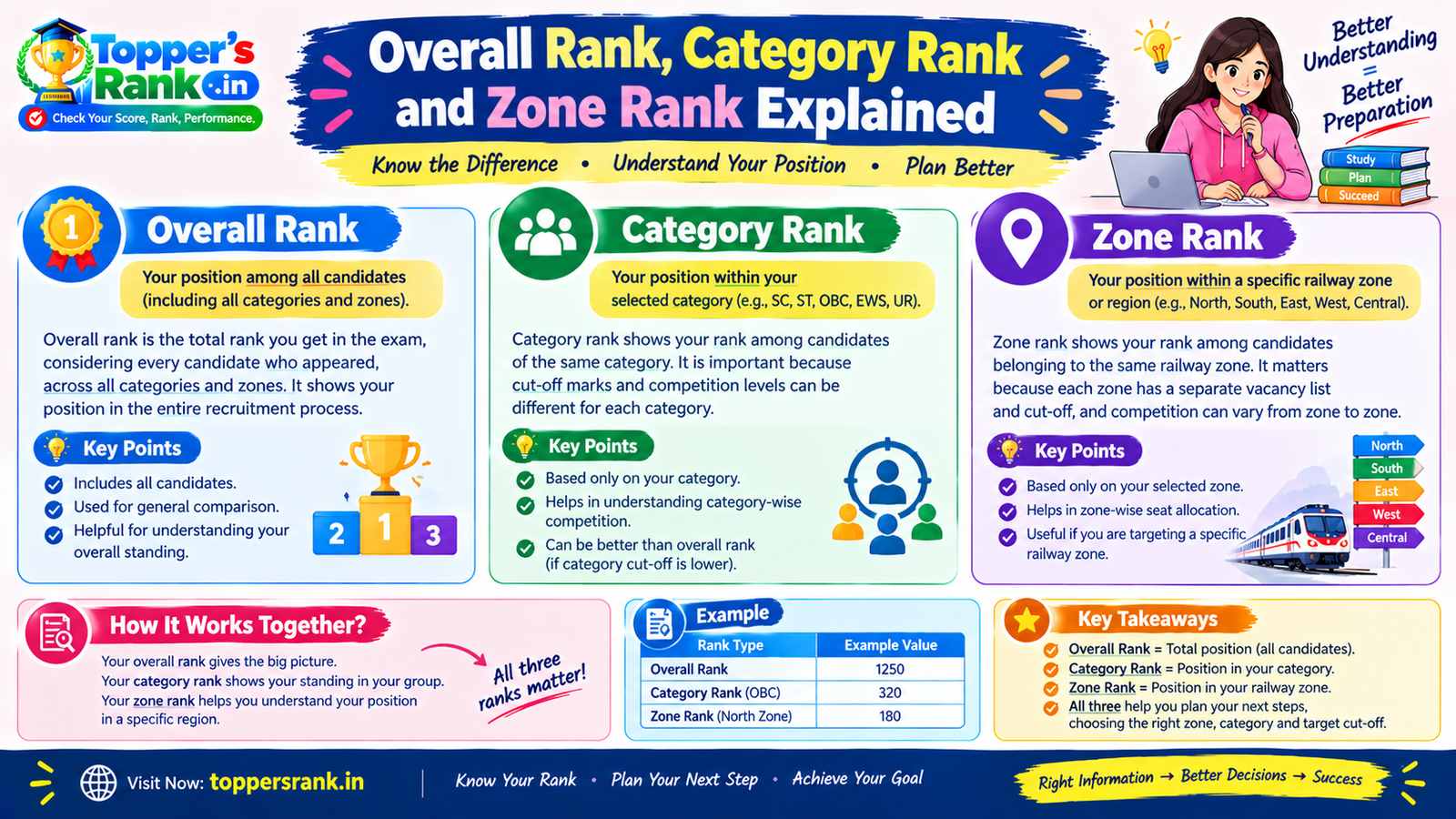
12. Answer-Key Marks Are Usually Raw Marks
One of the most important points to understand is that marks calculated from an answer key are generally raw marks.
Raw marks are based directly on your correct and incorrect responses under the exam's marking scheme.
However, the official result may use additional processes.
Depending on the examination, these can include:
- Shift normalization
- Percentile calculation
- Equating methods
- Sectional qualification
- Category-wise qualifying marks
- Tie-breaking rules
- Post-wise merit rules
- Zone-wise merit
- Reservation rules
- Eligibility verification
As a result, your calculated raw score may not always match the final score or merit position shown in the official result.
13. Normalization Can Affect the Final Score
In examinations conducted across multiple shifts, different sets of questions may be used.
If the examination authority applies normalization, the raw marks may be adjusted using its official methodology.
This means two candidates with similar raw marks from different shifts may not necessarily receive exactly the same normalized score.
Candidates should therefore avoid assuming that a raw-score comparison alone determines the final merit position in a normalized examination.
Always check whether the official recruitment notice or examination scheme mentions normalization, percentile scoring, equating, or another adjustment method.
14. Rank Prediction Is an Estimate, Not an Official Rank
Rank prediction can be useful for understanding your approximate position among available student submissions, but it should be interpreted carefully.
A predicted rank may depend on factors such as:
- Number of students who submitted their scores
- Accuracy of submitted data
- Category distribution
- Zone or region distribution
- Actual number of exam candidates
- Final answer-key changes
- Normalization
- Vacancy count
- Candidate preferences
- Recruitment rules
For example, if a platform has data from only a portion of all candidates, the displayed position represents comparison within that submitted dataset rather than the official all-India or final recruitment rank.
Use rank prediction as a planning and comparison tool, not as confirmation of selection.
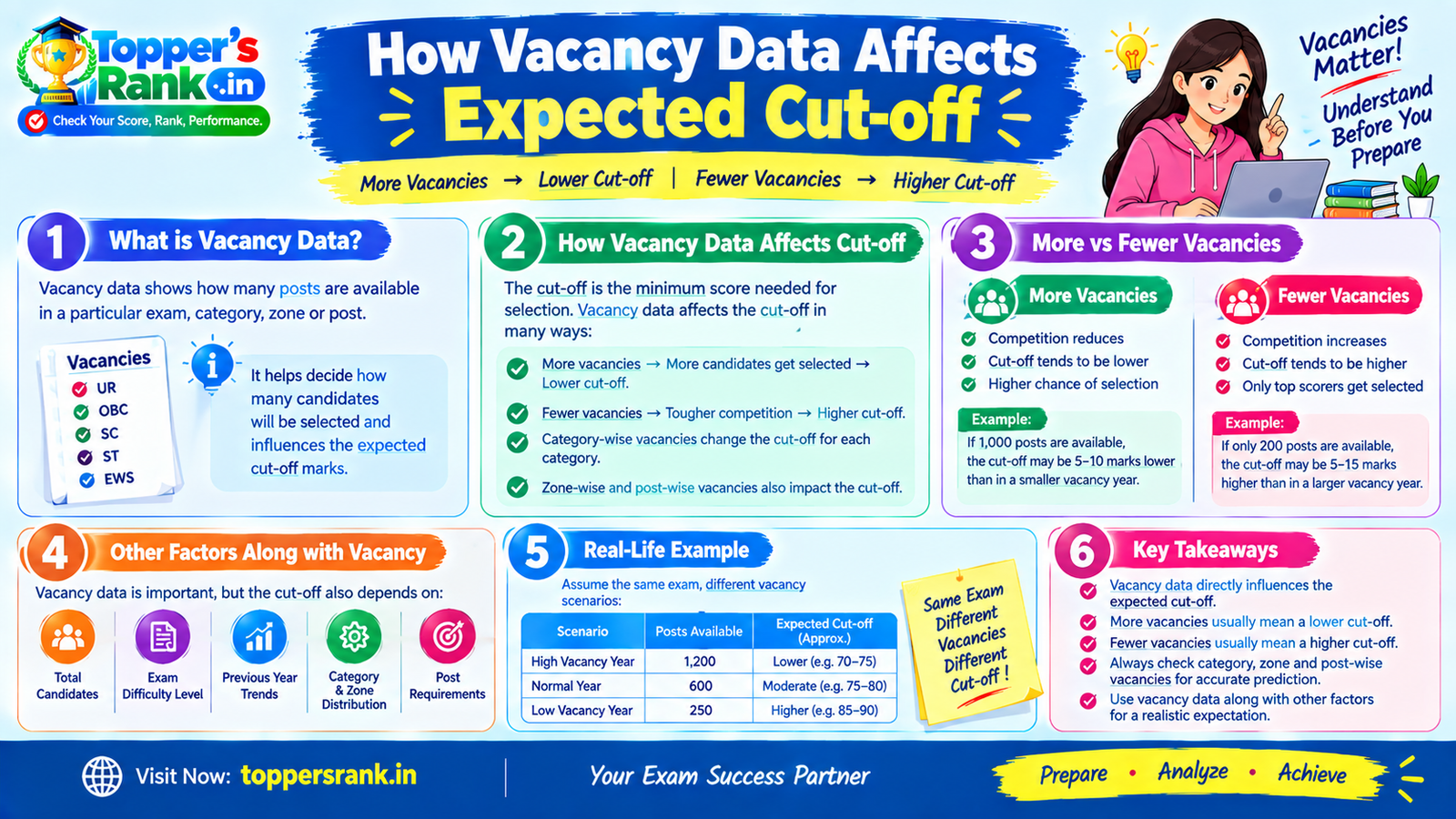
15. Vacancies Alone Do Not Guarantee Selection
Candidates often compare their rank directly with the number of vacancies. While vacancy data is important, final recruitment outcomes can depend on several additional factors.
These may include:
- Category-wise vacancies
- Zone-wise vacancies
- Post preference
- Horizontal reservation
- Eligibility rules
- Document verification
- Medical examination
- Skill or typing tests
- Physical standards
- Final cutoff rules
- Candidate withdrawals
- Tie-breaking criteria
Therefore, being within an estimated vacancy range does not automatically guarantee final selection.
Similarly, being slightly outside an early predicted range does not always mean selection is impossible.
16. Save Different Versions of Your Score
If both provisional and final answer keys are published, it can be helpful to keep separate score records.
For example:
Provisional Key Score: Your marks calculated from the initial answer key.
Final Key Score: Your marks calculated after answer-key revisions.
Official Result Score: The score eventually published by the examination authority.
Keeping these records helps you understand why your score may have changed during the recruitment process.
17. Do Not Rely Only on Screenshots
Screenshots are useful for quick reference, but they may not preserve all the information contained in a response-sheet webpage.
Whenever possible, save the original HTML file or PDF in addition to screenshots.
An HTML response sheet may contain important underlying information such as:
- Question IDs
- Option IDs
- Candidate response status
- Official answer indicators
- Structured question data
This can make later score calculation and verification easier.
18. Final Result Depends on the Official Recruitment Process
Calculating answer-key marks is only one part of understanding your examination performance.
Depending on the recruitment, final selection may also require:
- Clearing category-wise cutoff marks
- Passing a qualifying paper
- Passing a skill or typing test
- Passing a physical test
- Document verification
- Medical examination
- Meeting educational eligibility
- Meeting age and category requirements
- Completing preference allocation
- Appearing in the final merit list
A high raw score does not override these official eligibility or recruitment conditions.
A Simple Checklist After Answer-Key Release
Before closing the answer-key page, make sure you have:
- Saved your response sheet
- Saved the answer key
- Saved the HTML or PDF file
- Recorded your exam date and shift
- Confirmed the marking scheme
- Counted correct, wrong and unattempted responses
- Checked dropped and bonus questions
- Verified sectional rules
- Reviewed questionable answers
- Noted the objection deadline
- Saved proof of any submitted objection
- Calculated your provisional raw score
- Checked whether normalization applies
Final Advice
The period between an answer-key release and the official result can create a lot of uncertainty. The most useful approach is to work from official records, calculate carefully, and keep estimates separate from confirmed results.
Use your answer-key score to understand your performance. Use submitted-data rank comparisons to understand where you may stand relative to other available candidates. Use vacancy information to understand the level of competition.
But rely on the examination authority for the final answer key, normalized score, cutoff, merit list, and recruitment decision.
Toppers Rank is designed to make post-exam analysis easier, but calculated marks, rank estimates, and merit projections should always be treated as analytical guidance rather than an official recruitment result.
 Exam Guidance · 16 minHow To Save And Use Your Score Card Safely
 Exam Guidance · 18 minRRB ALP CBT-2 Score Analysis: Part A, Part B and Merit
 Exam Guidance · 10 minHow Vacancy Data Affects Expected Cut-off