# How Rank Prediction Works on Toppers Rank
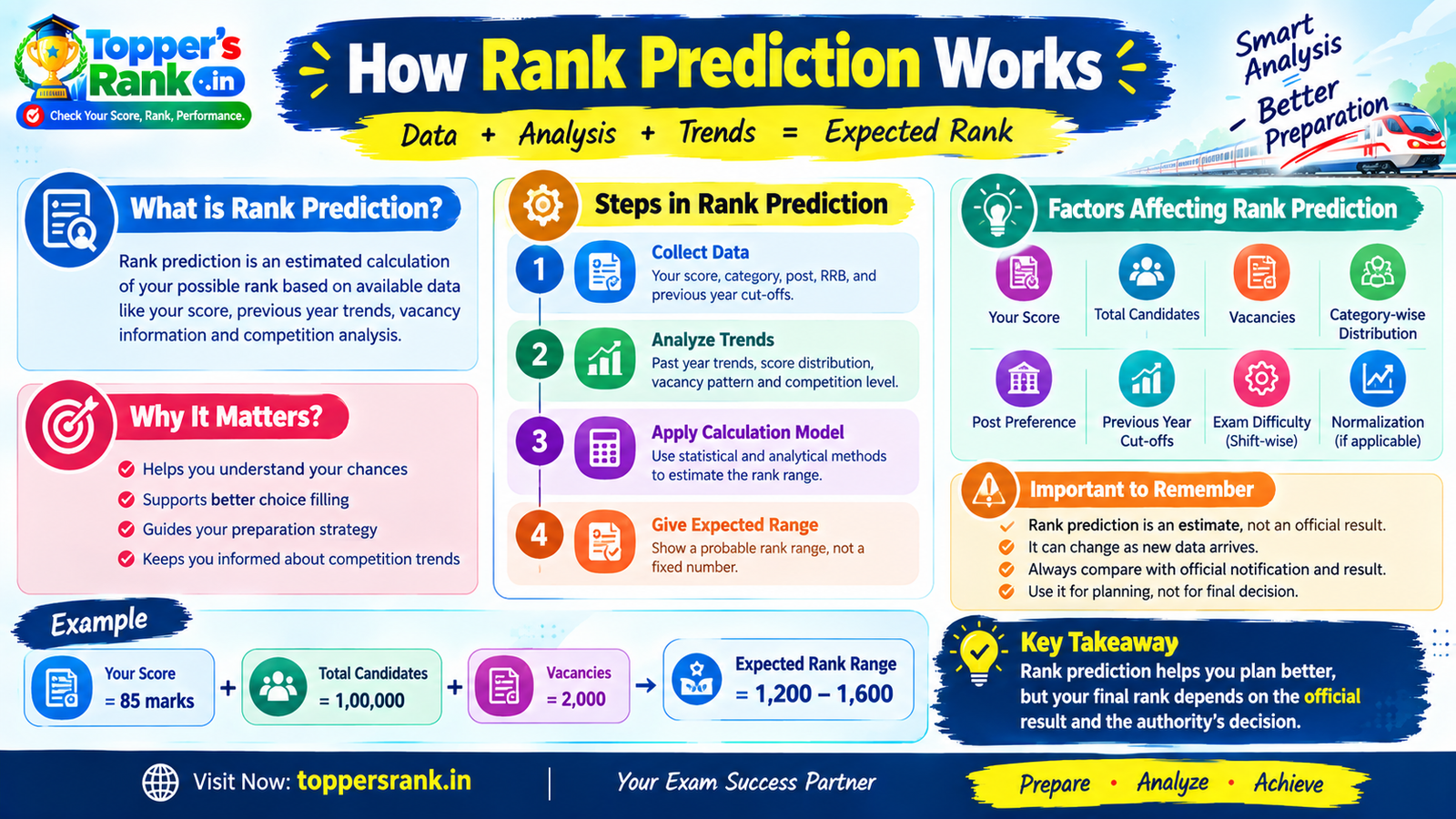
Rank prediction can be useful after an examination, but only when candidates clearly understand what the predicted rank is based on.
A rank shown immediately after an answer key or result is not automatically the same as the final official merit rank. The value of any prediction depends on the quality and quantity of the data available at that time.
On Toppers Rank, live rank is calculated using the student submissions currently available for the selected examination. These submissions may include answer-key scores, result details, category information, zone information, post preferences, and other exam-specific data where applicable.
As more students submit valid information, the comparison becomes broader and more meaningful.
The important point is that a live rank represents a candidate's position within the available submitted dataset. It should not be treated as the final official rank among every candidate who appeared in the examination.
What Does Live Rank Mean?
A live rank shows how your score compares with other candidates whose data has been submitted for the same examination on Toppers Rank.
For example, if 10,000 candidates have submitted their scores and your score is the 250th highest in the available data, your live submitted-data rank may be shown around that position.
However, if the actual examination was attended by several lakh candidates, the live rank cannot automatically be considered your final overall rank.
The platform may not yet have data from every candidate.
Therefore, live rank should be understood as:
Your current position among the student submissions available on Toppers Rank for that examination.
It is a comparison tool, not an official merit list.
Why Rank Prediction Changes Over Time
Students may notice that their live rank changes even when their marks remain the same.
This is normal.
A live rank can change whenever new students submit their data.
For example, suppose your initial rank is 150 out of 5,000 submitted candidates. Later, another 10,000 students submit their scores. Some of those candidates may have marks higher than yours, while others may have lower marks.
Your rank may therefore move upward or downward as the dataset grows.
This is why an early rank prediction should not be treated as permanent.
As more valid submissions become available, the rank comparison generally becomes more representative of the participating student sample.
Why the Number of Submitted Students Matters
The number of students included in the comparison is one of the most important factors when interpreting a predicted rank.
A rank based on 500 submissions is very different from a rank based on 50,000 submissions.
A larger dataset can provide a better view of:
- Score distribution
- Category competition
- Zone-wise competition
- High-score concentration
- Vacancy pressure
- Expected merit range
- Possible cutoff trends
However, even a large submitted dataset does not automatically become an official result.
Only the examination authority has access to the complete candidate data required to prepare the official merit list.
What Information Can Affect Rank Prediction?
A useful rank prediction depends on more than just total marks.
Depending on the examination, several factors may influence a candidate's actual competitive position.
These can include:
- Raw marks
- Normalized marks
- Candidate category
- Zone or region
- Post applied for
- Post preference
- Gender, where relevant to reservation rules
- Horizontal reservation
- Qualification status
- Sectional qualification
- Number of vacancies
- Category-wise vacancies
- Zone-wise vacancies
- Post-wise vacancies
- Tie-breaking rules
- Final answer-key changes
Not every examination uses all of these factors.
Toppers Rank aims to use the rules and information relevant to the specific examination wherever such data is available.
Raw Marks and Rank Prediction
In many examinations, the first score available after the answer key is released is the candidate's raw score.
Raw marks are generally calculated directly from:
- Correct answers
- Incorrect answers
- Negative marking
- Unattempted questions
- Bonus questions
- Dropped questions
A basic example may be:
Raw Score = Marks for Correct Answers − Negative Marks for Incorrect Answers
However, raw marks should not always be treated as final merit marks.
If the examination authority applies normalization or another score-adjustment method, the final score used for merit may be different.
Normalization Can Change Final Merit Position
Many large competitive examinations are conducted in multiple shifts.
When candidates receive different question papers across different shifts, the examination authority may use normalization or equating to account for differences in paper difficulty.
In such cases, the score calculated directly from the answer key may not be the exact score used in the final merit process.
For example:
Two candidates may receive similar raw marks but appear in different shifts. After normalization, their official scores may be adjusted differently depending on the methodology used by the examination authority.
This means that a rank prediction based only on raw marks should be treated carefully when normalization applies.
Toppers Rank can help candidates compare available score data, but the final normalized score remains under the control of the official examination authority.
Qualifying Marks and Merit Marks Are Not Always the Same
Some examinations contain multiple sections or papers, but not every section contributes to final merit.
For example, an examination may contain:
- Part A for qualifying purposes
- Part B for merit calculation
Or:
- Language section as qualifying
- Technical section for final ranking
In such situations, marks from a qualifying-only section should not automatically be added to the final merit score.
Candidates should check whether:
- All sections contribute to final merit
- Any section is qualifying only
- Sectional minimum marks apply
- Failure in one section causes disqualification
- Different parts carry different weightage
A meaningful rank prediction should follow the actual selection rules of the examination.
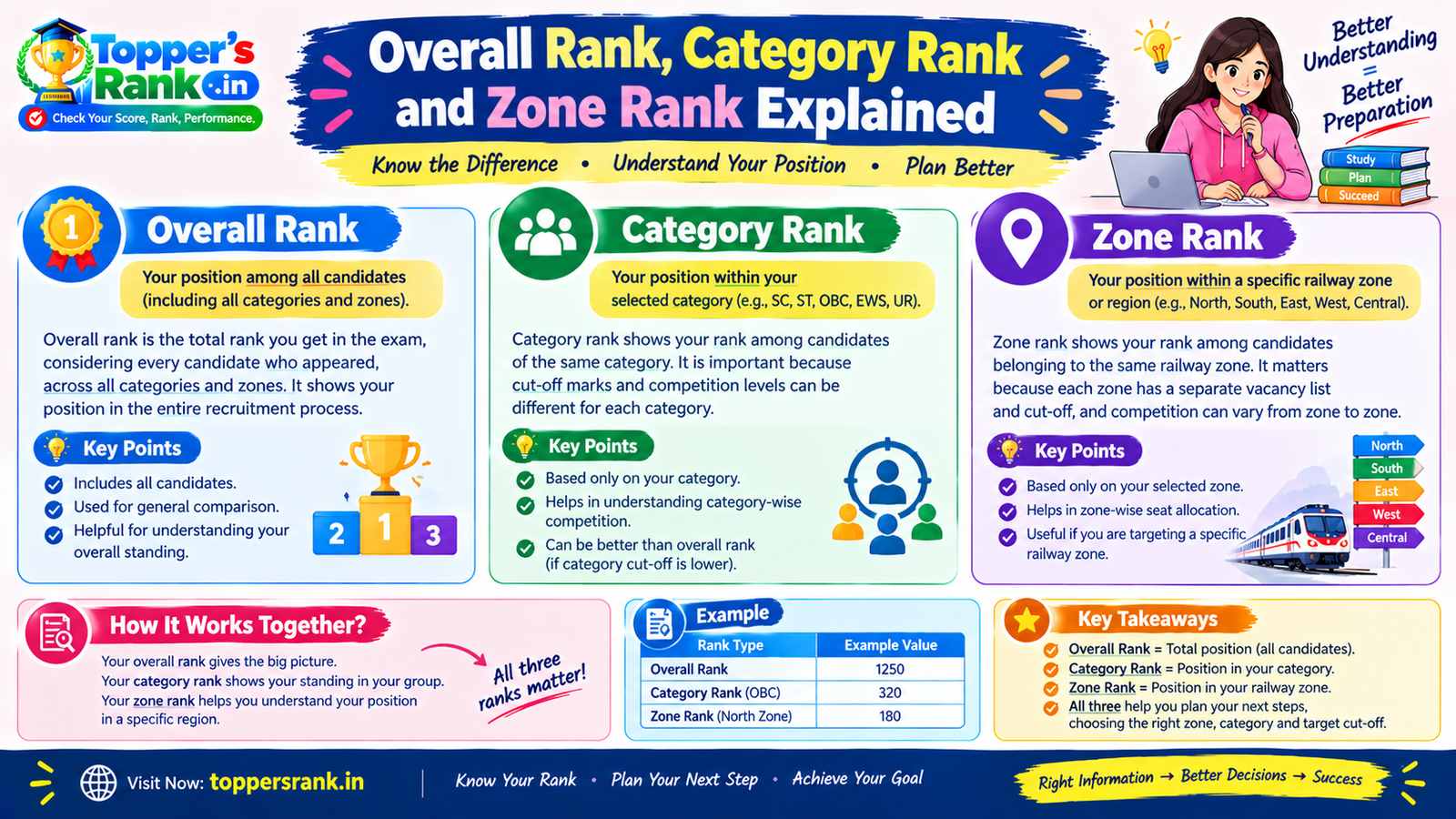
Category-Wise Rank
Category-wise rank can be more useful than overall rank for examinations where reservation rules apply.
A candidate may have an overall submitted-data rank of 5,000 but a much stronger position within a particular category.
Depending on the recruitment, categories may include:
- General or Unreserved
- OBC
- EWS
- SC
- ST
- Other exam-specific reservation groups
The exact category structure depends on the recruiting authority and examination rules.
Category-wise comparison helps candidates understand their position relative to other submitted candidates in the same category.
However, category rank is still based on the available student submissions and should not be treated as an official category merit number.
Zone-Wise Rank
Some examinations recruit candidates separately across different railway zones, regions, states, departments, circles, divisions, or other administrative units.
In such cases, all-India rank alone may not provide the most useful picture.
A candidate's competition can vary significantly depending on the selected zone.
For example, two candidates with identical marks may have different chances because:
- One zone has more vacancies
- One zone has fewer applicants
- Category distribution differs
- Higher-scoring candidates are concentrated in one region
- Post availability differs
Zone-wise rank can therefore help candidates understand competition within the location or recruitment unit relevant to their application.
Post-Wise Rank and Post Preference
Some recruitment examinations include multiple posts under a single examination.
Different posts may have:
- Different vacancy counts
- Different eligibility requirements
- Different medical standards
- Different skill requirements
- Different candidate preferences
- Different final cutoffs
A candidate may therefore be competitive for one post but not another, even with the same score.
Post-wise comparison becomes particularly useful when final allocation depends on both merit and candidate preference.
Candidates should remember that post preference can affect final allocation even when the examination score remains unchanged.
Why the Same Marks Can Produce Different Chances
Candidates often ask why two students with identical marks may have different selection chances.
The answer is that recruitment decisions may depend on more than marks alone.
Two candidates with the same score may belong to different:
- Categories
- Zones
- Posts
- Reservation groups
- Gender or horizontal reservation groups
- Preference combinations
They may also be affected differently by tie-breaking rules.
Therefore:
Same marks do not always mean the same final selection probability.
The exam's recruitment structure must be considered before drawing conclusions.
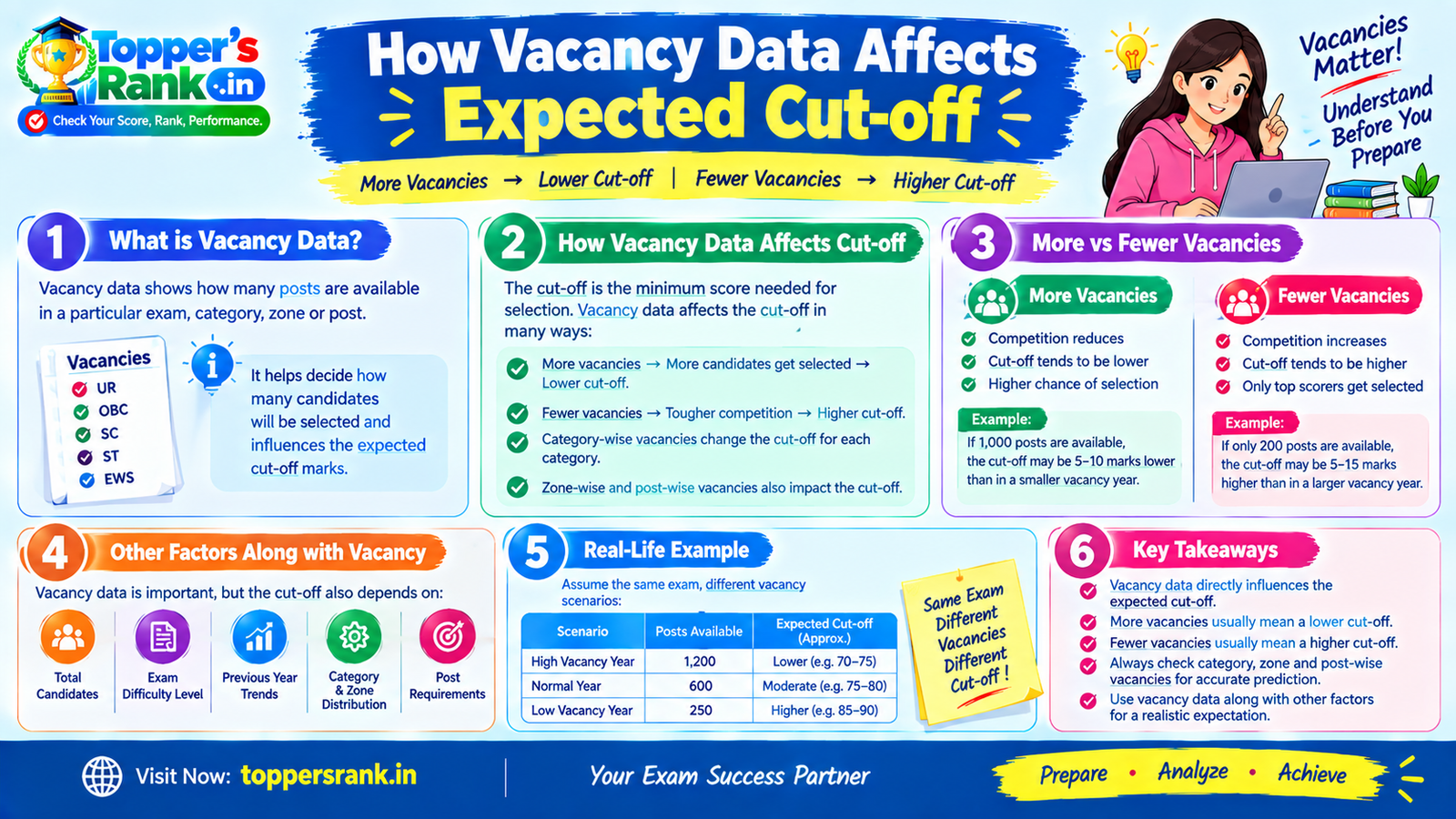
Role of Vacancy Data in Rank Prediction
Vacancy information is one of the most important inputs when estimating possible merit pressure.
A rank number becomes more useful when candidates can compare it with the number and distribution of available vacancies.
Useful vacancy information may include:
- Total vacancies
- Category-wise vacancies
- Zone-wise vacancies
- Post-wise vacancies
- Reservation-wise vacancies
- Revised vacancy notices
However, simply comparing overall rank with total vacancies can be misleading.
For example, an examination may have 10,000 total vacancies, but only a smaller portion may be available for a particular category, zone, or post.
Therefore, meaningful vacancy analysis should use the most relevant vacancy breakdown available.
Why Vacancies Do Not Directly Equal Final Rank
Suppose there are 5,000 vacancies and a candidate has a predicted rank of 4,500.
It may appear that the candidate is safely within the vacancy range.
However, this does not automatically guarantee selection.
Final recruitment may still depend on:
- Category distribution
- Zone allocation
- Post preferences
- Eligibility conditions
- Reservation rules
- Document verification
- Medical standards
- Skill tests
- Final answer-key changes
- Normalization
- Tie-breaking rules
Similarly, a candidate slightly outside the overall vacancy count may still remain competitive depending on category, zone, post allocation, or movement in later recruitment stages.
Vacancy numbers provide context, not a final selection guarantee.
When Expected Cutoff Can Be Useful
An expected cutoff can help candidates understand the approximate score range where competition may become stronger.
However, expected cutoff should only be shown when enough reliable data is available.
A useful cutoff estimate may depend on:
- Number of submitted candidates
- Score distribution
- Category distribution
- Vacancy count
- Zone-wise vacancies
- Post-wise vacancies
- Normalization rules
- Final answer-key status
- Historical exam patterns, where relevant
If the data is too limited, showing a precise expected cutoff can create a false impression of accuracy.
For this reason, Toppers Rank aims to avoid presenting highly specific merit projections when the supporting dataset is not strong enough.
Why Small Datasets Can Be Misleading
Imagine an examination with 20,000 vacancies but only 3,000 student submissions are currently available.
In that situation, almost every submitted candidate may appear to fall within the vacancy range.
This does not mean every candidate will necessarily be selected.
It simply means that the submitted sample is currently smaller than the available vacancy count.
A final merit projection under these conditions could be misleading because a large number of actual exam candidates are still not represented in the dataset.
In such cases, the more responsible approach is to continue showing useful information such as:
- Candidate marks
- Correct and incorrect answers
- Live submitted-data rank
- Category comparison
- Zone comparison
- Total submitted students
while keeping final merit or selection projection unavailable until the dataset becomes more meaningful.
When Toppers Rank May Show “Coming Soon”
A merit or cutoff projection may be displayed as Coming Soon when there is not yet enough data to support a useful estimate.
This may happen when:
- Too few students have submitted their scores
- Submitted students are fewer than vacancies
- Vacancy information is unavailable
- Category-wise vacancy data is incomplete
- Zone-wise information is missing
- Final answer key has not been released
- Exam rules are still being verified
- Normalization information is unclear
- Student data is not yet distributed widely enough
Showing “Coming Soon” in such situations is more transparent than presenting an unreliable prediction.
The candidate can still view available score analysis and live rank information while the dataset continues to grow.
Expected Cutoff Is Not an Official Cutoff
An expected cutoff is only an analytical estimate.
The official cutoff is decided and published by the examination or recruitment authority.
Final cutoff marks can be affected by:
- Number of candidates
- Difficulty level
- Final answer key
- Normalization
- Number of vacancies
- Category-wise vacancies
- Candidate performance
- Reservation rules
- Tie-breaking conditions
- Recruitment stages
A predicted cutoff should therefore be used only to understand the possible competitive range.
It should never be presented as a confirmed official cutoff.
Live Rank vs Official Rank
It is important to understand the difference between the two.
Live Rank
A live rank is calculated using the student submissions currently available on Toppers Rank.
It may change as new student data is submitted.
Official Rank
An official rank is calculated by the examination authority using the complete eligible candidate dataset and the official recruitment rules.
The official rank may take into account:
- Final marks
- Normalization
- Qualification rules
- Category rules
- Tie-breaking criteria
- Eligibility conditions
- Other recruitment rules
The two should not be confused.
Predicted Rank vs Final Merit List
A predicted rank is intended to help candidates understand their current competitive position.
A final merit list determines official selection or progression under the rules of the recruitment authority.
The final merit list may be prepared only after several stages, including:
- Final answer-key evaluation
- Normalization
- Result processing
- Category verification
- Skill tests
- Physical tests
- Document verification
- Medical examination
- Preference allocation
Therefore, a strong predicted rank should be treated as encouraging information, not as a confirmed appointment or selection.
How Candidates Should Use Rank Prediction
Rank prediction is most useful when it is treated as a planning tool.
Candidates can use it to:
- Understand their approximate competitive position
- Compare performance with other submitted candidates
- Review category-wise standing
- Check zone-wise competition
- Understand vacancy pressure
- Decide whether to prepare for the next recruitment stage
- Monitor how rankings change as more data is submitted
- Compare provisional and final answer-key scores
It should not be used as the sole basis for making important decisions about final selection.
What Makes a Rank Estimate More Reliable?
A rank estimate generally becomes more useful when:
- More students submit valid data
- Scores come from verified response sheets
- Category details are available
- Zone information is available
- Vacancy information is updated
- Post preferences are known
- Final answer key is available
- Exam-specific rules are correctly configured
- Qualification criteria are properly applied
The more complete the underlying data, the more meaningful the comparison can become.
However, even a strong prediction remains unofficial unless it is published by the examination authority.
A Simple Example
Suppose an examination has:
- 50,000 actual candidates
- 5,000 vacancies
- 12,000 student submissions on Toppers Rank
A candidate receives a live submitted-data rank of 1,200.
This means the candidate currently stands around position 1,200 within those 12,000 submitted records.
It does not automatically mean the candidate has official rank 1,200 among all 50,000 candidates.
As additional candidates submit their scores, the live rank may change.
If sufficient vacancy, category, zone, and score-distribution data becomes available, the platform may later provide additional merit analysis.
Important Factors to Check Before Trusting Any Rank Prediction
Before relying on a predicted rank, candidates should check:
- How many students are included in the dataset
- Whether the rank is overall, category-wise, or zone-wise
- Whether raw or normalized marks are being used
- Whether final answer key changes are included
- Whether vacancy data is available
- Whether the exam contains qualifying sections
- Whether the displayed rank is live or official
- Whether post preference affects selection
- Whether category and reservation rules are included
A rank number without this context can easily be misunderstood.
Transparency Is More Important Than a Precise Number
Candidates naturally want a clear prediction after an examination.
However, showing an exact-looking number when the underlying data is incomplete can create unnecessary confusion.
Toppers Rank aims to prioritize transparency over false precision.
If enough student and vacancy data is available, additional comparisons and projections may be shown.
If the available information is not sufficient, the platform may continue showing the student's score and live submitted-data rank while clearly indicating that final merit projection is not yet available.
Final Advice
Rank prediction can help candidates understand their position, competition, and possible merit range after an examination.
The most useful way to interpret it is to look at the complete picture:
Marks + Submitted Students + Category + Zone + Post + Vacancies + Exam Rules
A live rank becomes more meaningful as more valid candidate data is available, but it remains a submitted-data comparison rather than an official recruitment rank.
Expected cutoffs and merit projections should also be interpreted carefully, particularly when student participation or vacancy information is limited.
Use Toppers Rank to understand your performance, compare your standing, and plan your next steps.
For final rank, cutoff, merit list, qualification status, and selection, always rely on the official examination or recruiting authority.
Toppers Rank provides analytical tools and student-data comparisons to support better understanding of exam performance. Live ranks, expected cutoffs, and merit projections are informational estimates and should not be treated as official recruitment results.
 Exam Guidance · 16 minHow To Save And Use Your Score Card Safely
 Exam Guidance · 18 minRRB ALP CBT-2 Score Analysis: Part A, Part B and Merit
 Exam Guidance · 10 minHow Vacancy Data Affects Expected Cut-off