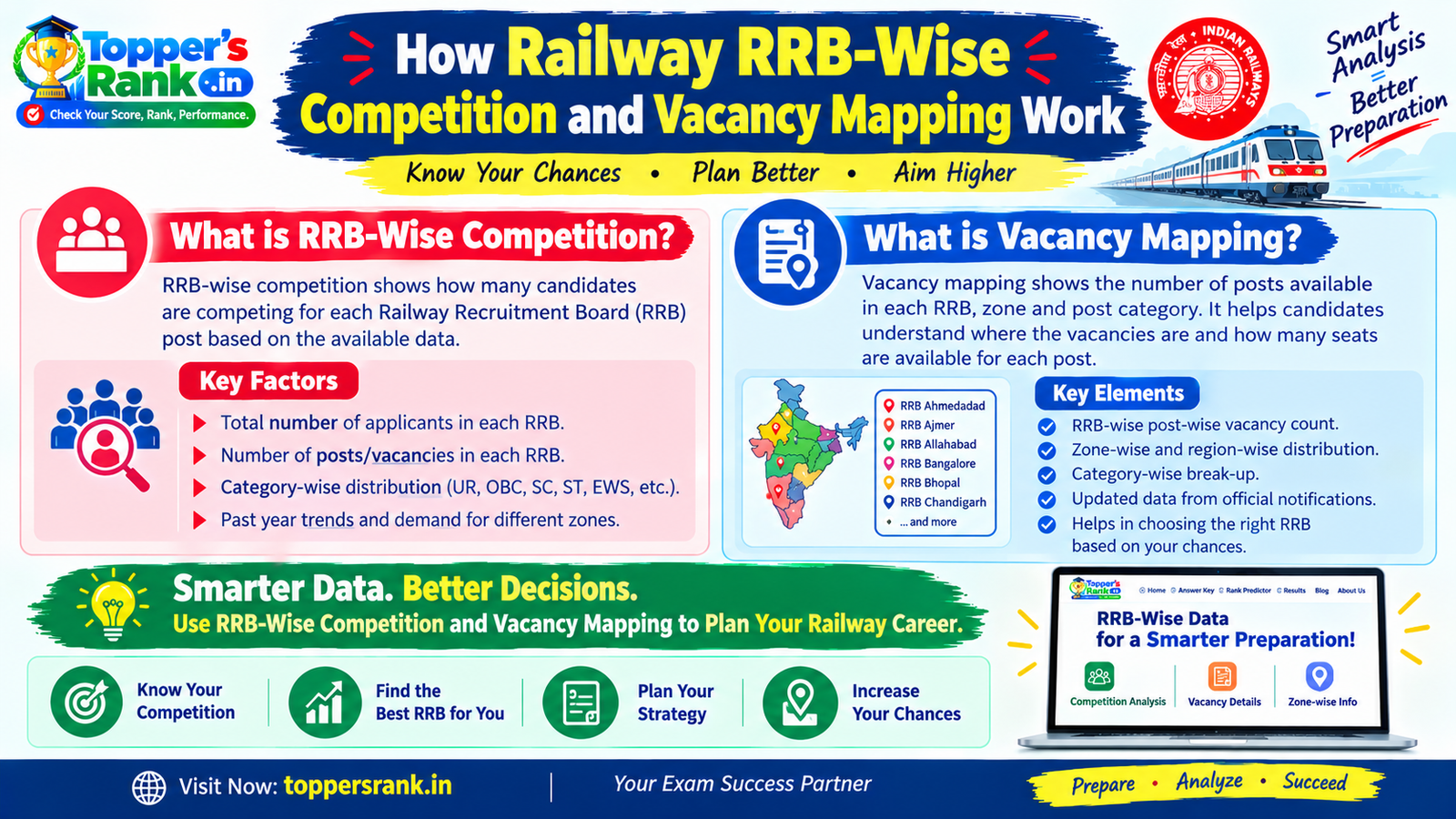
# How Railway RRB-Wise Competition and Vacancy Mapping Work
Complete Guide to RRB Selection, Internal Vacancy Mapping & Board-Wise Rank Samples
---
# English Version
Railway recruitment notifications often present vacancy information in a much more detailed format than what a candidate may initially see while applying. A recruitment process may involve multiple Railway Recruitment Boards (RRBs), zones, posts, categories and vacancy units. As a result, the vacancy table can contain several levels of information that are not immediately obvious from the application form.
Understanding how these vacancy tables work is important when analysing RRB-wise competition, vacancies, expected cut-offs and rank trends.
This guide explains three important concepts:
- Main RRB selection
- Internal vacancy mapping
- Limitations of voluntary board-wise rank samples
The purpose is to help candidates understand what the available data can—and cannot—tell them.
---
1. Why Railway Vacancy Tables Can Look Different from the Application View
When candidates apply for a railway recruitment examination, they generally select or indicate an RRB/railway recruitment preference according to the rules of that particular notification.
However, the official vacancy structure can be much more detailed.
A vacancy table may include information such as:
- RRB or recruitment board
- Railway zone
- Department
- Post
- Category
- UR vacancies
- OBC vacancies
- SC vacancies
- ST vacancies
- EWS vacancies
- Ex-servicemen or other applicable reservation categories
- Gender-specific vacancy information, where applicable
- Post-wise or unit-wise distribution
- Other recruitment-specific classifications
Therefore, the number of vacancies visible in one part of the recruitment process may not represent the entire underlying vacancy structure.
Example
Suppose a recruitment notification contains:
RRB A → Post X → 500 vacancies
Those 500 vacancies may then be divided internally into different categories, zones, departments or railway units.
The vacancy table can therefore contain many more rows than a candidate expects from the initial application interface.
---
# 2. What Is Main RRB Selection?
The main RRB selection refers to the primary recruitment-board choice or allocation mechanism defined by the particular Railway recruitment notification.
The exact process can differ between examinations, so candidates should always read the relevant official notification and application instructions.
An RRB is not necessarily the same thing as a single railway zone or a single workplace. The recruitment structure may connect:
Candidate → RRB → Post → Railway/Unit → Vacancy Category
The actual allocation process depends on the rules of the specific recruitment.
Why Main RRB Selection Matters
The RRB associated with an application can be an important starting point for analysing:
- Number of candidates
- Available vacancies
- Post distribution
- Category-wise vacancies
- Competition trends
- Expected cut-off analysis
- Subsequent selection stages
However, candidates should not assume that simply choosing an RRB means they are competing for every vacancy listed under that RRB.
The applicable notification determines the relationship between the RRB, post, railway unit and vacancy.
---
# 3. What Is Internal Vacancy Mapping?
Internal vacancy mapping means breaking down a broader RRB-level vacancy figure into the smaller units represented in the official vacancy structure.
For example:
RRB → Railway Zone → Department → Post → Category → Vacancies
A candidate might initially see a broad vacancy figure, while the official vacancy table may provide a much more granular breakdown.
Example of a Simplified Vacancy Map
| Level | Example | | ------------ | -------------- | | RRB | RRB Example | | Railway/Zone | Railway Zone A | | Department | Operations | | Post | Post X | | Category | OBC | | Vacancies | 120 |
This type of mapping helps analysts understand where vacancies actually exist instead of looking only at a total RRB-wise number.
---
# 4. Why Vacancy Mapping Is Important for Competition Analysis
A simple comparison such as:
“RRB A has 1,000 vacancies and RRB B has 500 vacancies.”
does not necessarily tell the complete story.
The number of candidates competing, their score distribution, applicable categories, post preferences and vacancy distribution can all affect the interpretation.
For example:
| RRB | Candidates in Sample | Vacancies | Simple Sample Ratio | | ----- | -------------------: | --------: | --------------------: | | RRB A | 10,000 | 1,000 | 10 candidates/vacancy | | RRB B | 6,000 | 500 | 12 candidates/vacancy |
This is only an illustrative calculation, not an actual recruitment prediction.
Even this ratio should not automatically be interpreted as the actual competition because the sample may not represent all applicants and eligibility/category/post restrictions may apply.
---
# 5. Vacancy Tables May Contain More Units Than Candidates Expect
One of the most common sources of confusion is treating every row of a vacancy table as if it represents a separate RRB choice.
It may not.
A single recruitment board can have multiple underlying vacancy units associated with different:
- Railways
- Production units
- Departments
- Posts
- Categories
- Locations
- Recruitment units
Therefore, when analysing a vacancy notification, it is useful to distinguish between:
RRB-level information
The recruitment board through which the recruitment is administered.
Railway/Unit-level information
The railway, production unit or other organizational unit to which vacancies may be mapped.
Post-level information
The specific job or post for which vacancies are advertised.
Category-level information
The applicable reservation category and associated vacancy count.
Keeping these levels separate helps prevent double counting.
---
# 6. How Internal Vacancy Mapping Can Be Built
A structured vacancy analysis can follow this sequence:
Step 1: Identify the RRB
Determine which Railway Recruitment Board is associated with the relevant recruitment/application.
Step 2: Identify the railway or unit
Check which railway, production unit or recruitment unit the vacancy belongs to.
Step 3: Identify the post
Separate vacancies by the advertised post or post category.
Step 4: Identify the reservation category
Map UR, OBC, SC, ST, EWS and other applicable categories separately.
Step 5: Check the vacancy rules
Some recruitment notifications contain specific rules about preferences, eligibility, medical standards, post suitability, or allocation.
Step 6: Avoid double counting
If the same vacancy is represented at multiple levels in different tables, do not add the figures together without checking whether they represent distinct vacancies.
---
# 7. What Is a Board-Wise Rank Sample?
A board-wise rank sample is a collection of voluntarily submitted candidate information that may be used to understand observed rank or score patterns across different RRBs.
For example, candidates may voluntarily provide:
- RRB selected
- Score
- Category
- Rank
- Post preference
- Shift information
- Other relevant details
This information can be useful for exploratory analysis.
However, a voluntary sample is not the same as the complete population of candidates.
---
# 8. Why a Voluntary Rank Sample Has Limitations
This is one of the most important points when interpreting RRB-wise data.
Candidates who voluntarily submit their information may differ from candidates who do not participate in the sample.
For example:
- Higher-scoring candidates may be more willing to submit scores.
- Some candidates may submit multiple times.
- Some regions may have more active participants.
- Some candidates may not know their final official rank.
- Category information may be incomplete.
- Scores may be self-reported.
- Some candidates may enter incorrect information.
- The number of responses may vary significantly between RRBs.
Because of these factors, a board-wise sample should not automatically be treated as a complete representation of actual competition.
---
# 9. Sample Size Matters
Suppose two RRBs have the following voluntary samples:
| RRB | Sample Responses | | ----- | ---------------: | | RRB A | 5,000 | | RRB B | 250 |
The data from RRB A may contain a much larger number of observations than RRB B.
That does not automatically mean that RRB A has 20 times more candidates.
It only means that more responses were collected from RRB A within that particular sample.
This distinction is essential.
Sample Size ≠ Total Candidate Count
A voluntary dataset should therefore be described as:
“Observed sample data”
rather than:
“Complete candidate population.”
---
# 10. Why Board-Wise Rank Data Can Still Be Useful
Despite its limitations, voluntary data can provide useful descriptive information.
It may help identify:
- Observed score ranges
- Observed rank ranges
- Distribution patterns
- Differences in submitted data between boards
- Areas where additional data is needed
- Changes in trends as more candidates submit information
However, these observations should be presented with appropriate uncertainty.
For example:
“Among the candidates represented in the submitted sample, scores in this range were observed.”
This is more precise than claiming:
“All candidates in this RRB scored within this range.”
---
# 11. How RRB-Wise Competition Should Be Interpreted
Competition should not be calculated from vacancies alone.
A broader analysis may consider:
Competition Context = Candidate Data + Vacancy Data + Category + Post + Applicable Rules
The available sample may then be compared with the relevant vacancy structure.
But this remains an analytical estimate unless complete official candidate-level data is available.
---
# 12. Vacancy Count vs Competition
A large vacancy count does not automatically mean lower competition.
Similarly, a smaller vacancy count does not automatically mean higher competition.
For meaningful comparison, analysts may need to consider:
- Number of eligible candidates
- Number of candidates actually appearing
- Number of candidates represented in the sample
- Category-wise candidate distribution
- Post-wise vacancies
- RRB-wise vacancy distribution
- Candidate score distribution
- Selection rules
- Preference and allocation rules
This is why vacancy mapping and candidate-data analysis should be performed together rather than separately.
---
# 13. How Candidates Should Read an RRB-Wise Analysis
When viewing an RRB-wise competition or rank analysis, check the following:
1. Data source
Is the information official, self-reported, or collected through a voluntary survey?
2. Sample size
How many candidates are represented?
3. Date of data
When was the data collected?
4. Vacancy source
Are vacancies taken from an official notification?
5. Category
Are the figures category-specific or combined?
6. Post
Are different posts being analysed separately?
7. Methodology
How has the competition or rank estimate been calculated?
8. Updates
Can the analysis change when additional data arrives?
These questions help candidates distinguish between official information and analytical estimates.
---
# 14. A Responsible Way to Use RRB-Wise Data
RRB-wise analysis can be useful for understanding the recruitment landscape, but candidates should avoid treating sample-based numbers as guaranteed selection outcomes.
A practical approach is:
Official Vacancy Data → Internal Vacancy Mapping → Candidate Sample → Trend Analysis → Updated Estimate → Official Result
The further an estimate moves away from complete official data, the more carefully its limitations should be considered.
---
# 15. Key Difference Between Official Data and Sample Data
| Official Data | Voluntary Sample Data | | ------------------------------------------------------- | ----------------------------------------------- | | Published by the relevant authority | Submitted by participating candidates | | Generally represents the official recruitment structure | Represents only the collected sample | | Used for official vacancy information | Used for analysis and trends | | Subject to official rules and notifications | May contain incomplete or incorrect submissions | | Can be updated through official notices | Can change as more people participate |
---
# Final Takeaway
Railway vacancy tables can contain significantly more detail than the basic RRB choice visible during application. A proper analysis therefore needs to distinguish between the main RRB, railway/unit, post, category and individual vacancy units.
Internal vacancy mapping helps connect these different levels and prevents analysts from treating every row of a detailed vacancy table as a separate RRB or from accidentally counting the same vacancy more than once.
At the same time, a voluntary board-wise rank sample should be treated as sample data, not as the complete candidate population. Its usefulness depends on sample size, data quality, category coverage, timing and methodology.
For candidates, the safest interpretation is to use RRB-wise competition and vacancy analysis as informational evidence for understanding trends, while relying on the relevant official Railway recruitment notification, subsequent official notices and final results for authoritative information.
---
# हिंदी संस्करण
# Railway RRB-Wise Competition और Vacancy Mapping कैसे काम करता है?
इस Guide में तीन मुख्य विषयों को समझाया गया है:
- Main RRB Selection
- Internal Vacancy Mapping
- Voluntary Board-wise Rank Sample की Limitations
---
लग क्यों दिखाई दे सकती है?
एक Vacancy Table में निम्न जानकारी शामिल हो सकती है:
- RRB
- Railway Zone
- Department
- Post
- UR Vacancy
- OBC Vacancy
- SC Vacancy
- ST Vacancy
- EWS Vacancy
न्य Reservation Categories
- Post-wise Vacancy
- Unit-wise Vacancy
- Recruitment-specific classifications
इसलिए Application में दिखाई देने वाली जानकारी को पूरी Vacancy Structure के बराबर नहीं मानना चाहिए।
उदाहरण
मान लीजिए किसी Recruitment में:
RRB A → Post X → 500 Vacancies
दिखाई जाती हैं।
---
# 2. Main RRB Selection क्या है?
Main RRB Selection से आशय उस Primary RRB Choice या Allocation Mechanism से है जो संबंधित Railway Recruitment Notification में निर्धारित होता है।
हर Railway Examination में Selection और Allocation के नियम समान हों, यह जरूरी नहीं है। इसलिए संबंधित Official Notification के नियमों को देखना महत्वपूर्ण है।
एक सामान्य Structure इस प्रकार समझा जा सकता है:
Candidate → RRB → Post → Railway/Unit → Vacancy Category
लेकिन इसका वास्तविक संबंध संबंधित Recruitment के Rules पर निर्भर करता है।
Main RRB Selection क्यों महत्वपूर्ण है?
RRB-wise analysis में शुरुआत के लिए RRB से संबंधित जानकारी उपयोगी हो सकती है, जैसे:
- Candidates की संख्या
- Available Vacancies
- Post Distribution
- Category-wise Vacancies
- Competition Trends
- Expected Cut-off Analysis
- Selection Process से संबंधित जानकारी
यह संबंध संबंधित Official Notification के नियमों से निर्धारित होता है।
---
# 3. Internal Vacancy Mapping क्या है?
इसे इस तरह समझ सकते हैं:
RRB → Railway/Zone → Department → Post → Category → Vacancy
सरल उदाहरण
| Level | उदाहरण | | ------------ | -------------- | | RRB | RRB Example | | Railway/Zone | Railway Zone A | | Department | Operations | | Post | Post X | | Category | OBC | | Vacancies | 120 |
इस प्रकार की Mapping से यह समझने में मदद मिलती है कि Vacancies वास्तव में किस स्तर पर उपलब्ध हैं।
---
# 4. Competition Analysis में Vacancy Mapping क्यों जरूरी है?
केवल यह कहना:
“RRB A में 1,000 Vacancies हैं और RRB B में 500 Vacancies हैं।”
पूरी Competition स्थिति नहीं बताता।
Candidate Count, Score Distribution, Category, Post, Preference और Vacancy Distribution जैसे Factors भी महत्वपूर्ण हो सकते हैं।
उदाहरण के लिए:
| RRB | Sample Candidates | Vacancies | Simple Sample Ratio | | ----- | ----------------: | --------: | --------------------: | | RRB A | 10,000 | 1,000 | 10 Candidates/Vacancy | | RRB B | 6,000 | 500 | 12 Candidates/Vacancy |
यह केवल Illustrative Example है, वास्तविक Railway Recruitment Data या Selection Prediction नहीं।
साथ ही, इस Ratio को वास्तविक Competition का पूर्ण माप नहीं माना जा सकता, क्योंकि Sample में सभी Candidates शामिल होना जरूरी नहीं है और Category, Post तथा Eligibility से जुड़े नियम भी लागू हो सकते हैं।
---
ऐसा जरूरी नहीं है।
- Railways
- Production Units
- Departments
- Posts
- Categories
- Locations
- Recruitment Units
हो सकते हैं।
RRB Level
Recruitment Board जिसके माध्यम से भर्ती प्रक्रिया संचालित की जाती है।
Railway/Unit Level
Post Level
वह Specific Post जिसके लिए Vacancy निकाली गई है।
Category Level
UR, OBC, SC, ST, EWS आदि लागू Reservation Category।
---
# 6. Internal Vacancy Mapping कैसे बनाई जा सकती है?
एक व्यवस्थित Vacancy Analysis के लिए निम्न Steps उपयोग किए जा सकते हैं:
Step 1: RRB Identify करें
देखें कि संबंधित Recruitment/Application किस RRB से जुड़ा है।
Step 2: Railway या Unit Identify करें
देखें कि Vacancy किस Railway, Production Unit या Recruitment Unit से संबंधित है।
Step 3: Post Identify करें
Step 4: Category Identify करें
Step 5: Vacancy Rules Check करें
Notification में Preference, Eligibility, Medical Standards, Post Suitability और Allocation से संबंधित नियम हो सकते हैं।
Step 6: Double Counting से बचें
---
# 7. Board-Wise Rank Sample क्या होता है?
Candidates इनमें से कुछ जानकारी दे सकते हैं:
- RRB
- Score
- Category
- Rank
- Post Preference
- Shift
न्य संबंधित जानकारी
ऐसा Data Exploratory Analysis में उपयोगी हो सकता है।
लेकिन इसे सभी Candidates के Complete Data के बराबर नहीं माना जा सकता।
---
# 8. Voluntary Rank Sample की Limitations क्या हैं?
यह RRB-wise Analysis का सबसे महत्वपूर्ण हिस्सा है।
उदाहरण के लिए:
धिक बार Data Submit कर सकते हैं।
धिक Responses मिल सकते हैं।
पना Final Official Rank पता न हो।
धूरी हो सकती है।
- Score Self-reported हो सकता है।
- कुछ Entries गलत हो सकती हैं।
इसलिए Voluntary Sample को Actual Complete Competition का प्रतिनिधि मानना उचित नहीं है।
---
# 9. Sample Size क्यों महत्वपूर्ण है?
मान लीजिए:
| RRB | Voluntary Sample | | ----- | ---------------: | | RRB A | 5,000 | | RRB B | 250 |
RRB A के पास RRB B की तुलना में बहुत बड़ा Sample है।
Sample Size ≠ Total Candidate Count
इसलिए Voluntary Data को बेहतर तरीके से इस रूप में बताया जाना चाहिए:
“Observed Sample Data”
न कि:
“Complete Candidate Population.”
---
# 10. फिर Board-Wise Rank Data उपयोगी क्यों हो सकता है?
Limitations के बावजूद Voluntary Data कुछ Descriptive Information दे सकता है।
यह देखने में मदद कर सकता है:
- Observed Score Range
- Observed Rank Range
- Score Distribution
धिक Data की आवश्यकता है
- नए Data आने पर Trends में होने वाले बदलाव
लेकिन इन Observations को उचित Uncertainty के साथ प्रस्तुत करना चाहिए।
उदाहरण:
“Submitted Sample में इस Score Range के Candidates देखे गए।”
“इस RRB के सभी Candidates इसी Score Range में हैं।”
---
# 11. RRB-Wise Competition को कैसे समझें?
Competition को केवल Vacancy Count से निर्धारित नहीं किया जाना चाहिए।
एक व्यापक Analysis में शामिल हो सकते हैं:
Competition Context = Candidate Data + Vacancy Data + Category + Post + Applicable Rules
इसके बाद Available Candidate Sample को संबंधित Vacancy Structure के साथ देखा जा सकता है।
लेकिन जब तक Complete Official Candidate-level Data उपलब्ध न हो, इसे Analytical Estimate ही माना जाना चाहिए।
---
# 12. Vacancy Count और Competition एक ही चीज नहीं हैं
RRB-wise Analysis में निम्न Factors को ध्यान में रखा जा सकता है:
- Eligible Candidates की संख्या
- परीक्षा में उपस्थित Candidates
- उपलब्ध Sample में Candidates की संख्या
- Category-wise Candidate Distribution
- Post-wise Vacancies
- RRB-wise Vacancy Distribution
- Score Distribution
- Selection Rules
- Preference और Allocation Rules
---
# 13. RRB-Wise Analysis देखते समय किन बातों की जांच करें?
1. Data Source
क्या Data Official है या Candidate द्वारा Self-reported?
2. Sample Size
कितने Candidates Analysis में शामिल हैं?
3. Data Date
Data कब Collect किया गया?
4. Vacancy Source
क्या Vacancy Data Official Notification से लिया गया है?
5. Category
क्या Data Category-wise है या सभी Categories को एक साथ दिखाया गया है?
6. Post
7. Methodology
Competition या Rank Estimate किस Method से तैयार किया गया है?
8. Updates
क्या नए Data आने पर Analysis बदल सकता है?
---
# 14. RRB-Wise Data का Responsible उपयोग कैसे करें?
RRB-wise Analysis Recruitment Landscape को समझने में मदद कर सकता है, लेकिन Sample-based Numbers को Guaranteed Selection Outcome नहीं माना जाना चाहिए।
एक सामान्य Analysis Flow इस तरह समझा जा सकता है:
Official Vacancy Data → Internal Vacancy Mapping → Candidate Sample → Trend Analysis → Updated Estimate → Official Result
---
---
दूसरी ओर, Voluntary Board-wise Rank Sample को Complete Candidate Population नहीं माना जाना चाहिए। इसकी उपयोगिता Sample Size, Data Quality, Category Coverage, Collection Date और Analysis Methodology पर निर्भर करती है।
उम्मीदवार RRB-wise Competition और Vacancy Analysis का उपयोग Recruitment Trends और उपलब्ध Data को समझने के लिए कर सकते हैं। लेकिन Official Vacancy, Eligibility, Allocation और Final Selection से संबंधित जानकारी के लिए संबंधित Railway Recruitment Authority की Official Notification, Official Updates और Final Result को ही प्राथमिक आधार माना जाना चाहिए।
 Exam Guidance · 16 minHow To Save And Use Your Score Card Safely
 Exam Guidance · 18 minRRB ALP CBT-2 Score Analysis: Part A, Part B and Merit
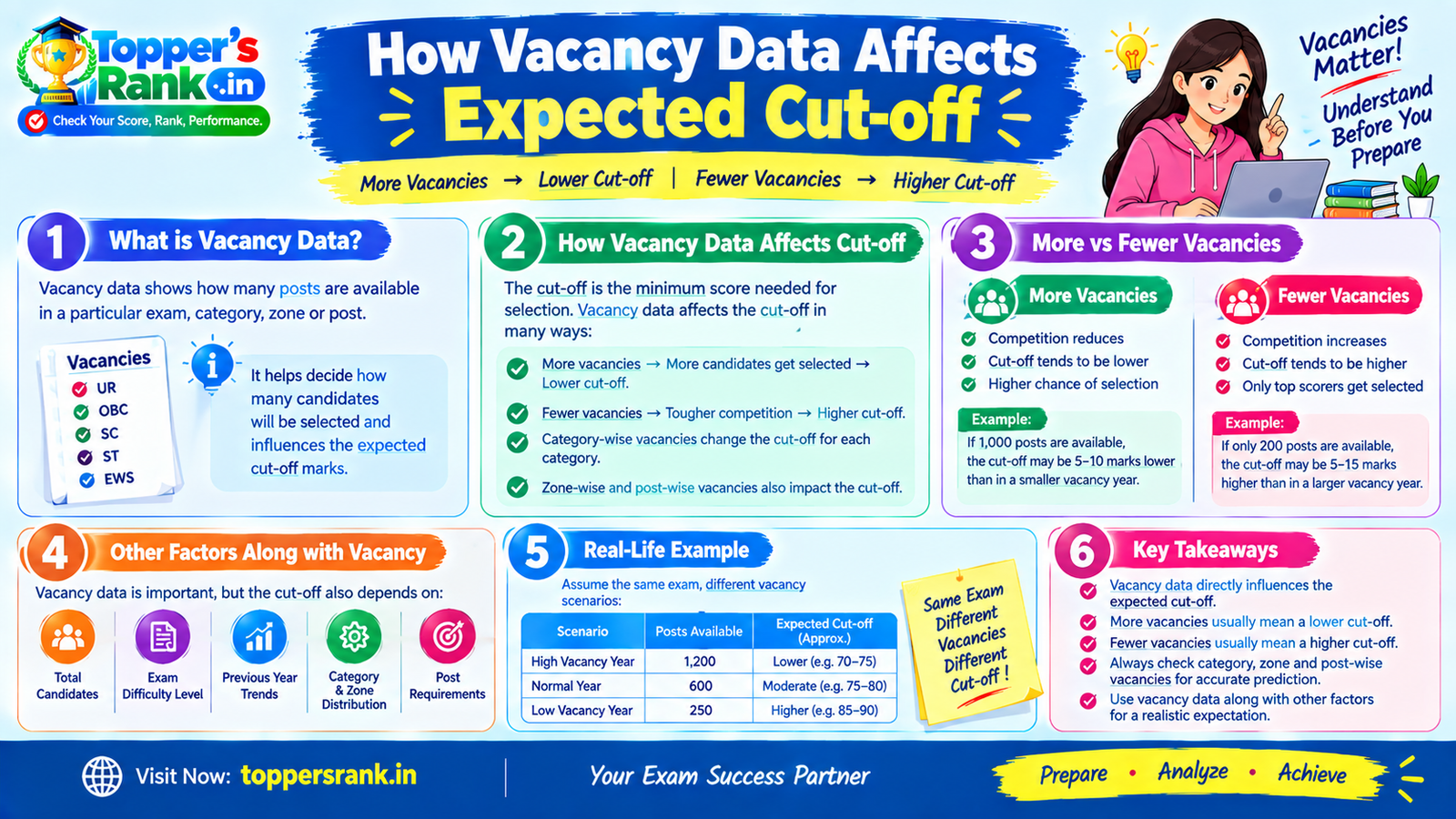 Exam Guidance · 10 minHow Vacancy Data Affects Expected Cut-off