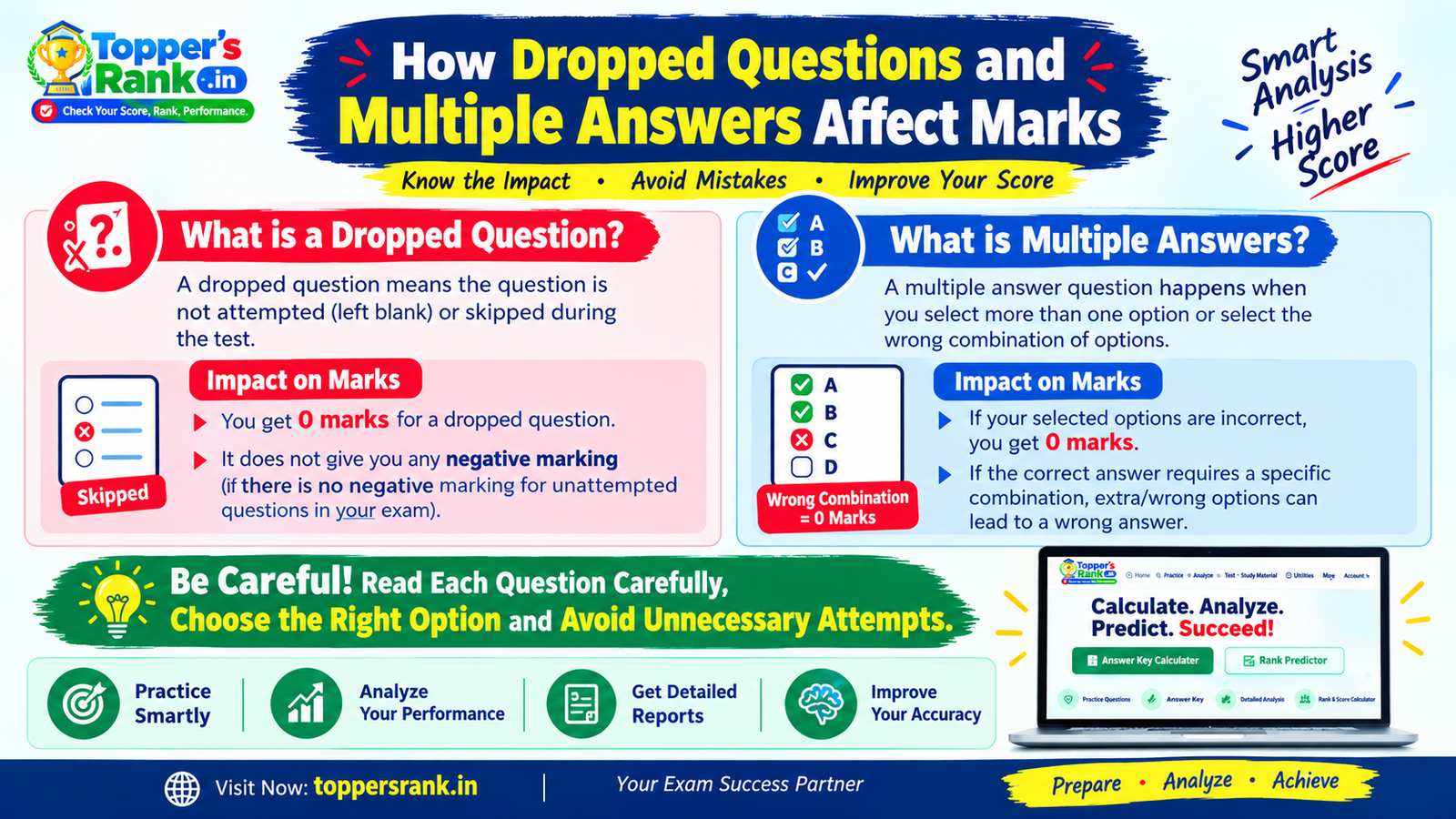
# How Dropped Questions and Multiple Answers Affect Marks
Dropped Questions, Revised Answer Keys & Question-ID Based Score Audit
English
In competitive examinations, the final score is not always determined only by the answers a candidate originally selected. Dropped questions, revised answer keys, multiple correct answers, changes in official answers, and changes in the marking scheme can all affect the final result.
A particularly important situation occurs when an examination authority drops a question after the examination or changes the accepted answer in a revised/final answer key. In such cases, the number of correct answers, wrong answers, marks obtained, negative marks, and sometimes even the maximum possible score can change.
However, there is no single universal rule for dropped questions. Different examination authorities and different examinations may apply different methods. For example, an authority may award marks to all candidates, remove the question from evaluation, accept more than one option as correct, or apply another officially notified procedure.
Therefore, candidates should not calculate their revised score simply by counting the questions they remember answering correctly. A more reliable approach is to perform a question-ID based audit.
---
1. What Is a Dropped Question?
A dropped question is a question that the examination authority decides should no longer be evaluated in the original manner.
This may happen because of:
- An incorrect question
- An incorrect or ambiguous option
- More than one option being considered correct
- No option being correct
- Translation errors
- Printing or technical errors
- A question being outside the prescribed syllabus
- An error identified after objections
- A change made after reviewing candidate challenges
A question may initially appear in the provisional answer key but later be deleted, withdrawn, or treated differently in the revised/final answer key.
Important Point
The term "dropped" does not automatically mean the same thing in every examination.
For one examination, a dropped question may be removed from evaluation completely. In another, the authority may award marks according to a specific rule. Therefore, the official notification, revised answer key, and marking instructions should always be checked before calculating the final score.
---
# 2. Why Can a Dropped Question Change Your Score?
Suppose an examination has:
- 100 questions
- +1 mark for a correct answer
- −0.25 mark for an incorrect answer
- 0 marks for an unattempted question
A candidate initially has:
- Correct = 70
- Wrong = 20
- Unattempted = 10
Initial score:
70 − (20 × 0.25) = 65 marks
Now suppose one of the questions is dropped.
The effect depends on what happened to that question under the official rules.
If the candidate had answered that question correctly, the candidate may lose the corresponding positive mark if the question is removed from evaluation.
If the candidate had answered it incorrectly, the negative mark may disappear.
If the candidate had left it unattempted, there may be no direct change to the candidate's score—but the maximum possible score may change if the question is removed from the evaluation.
This is why simply saying:
"One question was dropped, so everyone gets one extra mark"
can be incorrect.
---
# 3. Dropped Questions Can Affect Correct and Wrong Counts
When auditing a revised answer key, do not look only at the final marks.
You should separately track:
Correct Answers
How many questions are finally treated as correct according to the applicable answer key?
Wrong Answers
How many attempted questions are finally treated as incorrect?
Unattempted Questions
How many questions were left unanswered?
Dropped Questions
Which question IDs have been removed or specially treated?
Multiple-Correct Questions
Which questions have more than one officially accepted answer?
These categories can affect the calculation differently.
---
# 4. Multiple Answers Are Not Always the Same as a Dropped Question
A question may initially have four options:
A, B, C, D
Suppose the provisional key says:
Correct Answer: B
After objections, the authority may determine that B and C are both valid answers.
This situation is different from simply dropping the question.
The authority may specify that candidates who selected either accepted option will receive marks.
For example:
| Question | Provisional Key | Revised Key | | -------- | --------------- | ------------ | | Q25 | B | B/C accepted |
A candidate who selected B may receive marks.
A candidate who selected C may also receive marks if the official revised rules say both are accepted.
A candidate who selected A or D may still be treated as incorrect.
Never assume the treatment of a multiple-answer question. Check the official revised key or notification.
---
# 5. The Maximum Score Can Also Change
This is one of the most overlooked effects.
Suppose an examination originally contains:
100 questions × 1 mark = 100 marks
If the authority removes one question from evaluation and the examination rules do not compensate for it, the effective maximum may become:
99 marks
However, another examination may retain a 100-mark scale by using a different normalization or scoring procedure.
Therefore, you should distinguish between:
Original Maximum Marks
The maximum score announced before the examination.
Effective Maximum Marks
The maximum score applicable after revisions, dropped questions, or other official changes.
Candidate's Obtained Marks
The marks calculated using the final applicable rules.
These three values should not automatically be assumed to be identical.
---
# 6. Why a Question-ID Based Audit Is Better
A question-ID based audit means that you track each question individually rather than only comparing the final total.
For example:
| Question ID | Your Answer | Old Key | Revised Key | Status | Marking Impact | | ----------- | ----------- | ------- | ----------- | ---------------------- | ------------------- | | Q101 | B | B | B | Correct | +1 | | Q102 | C | B | C | Correct after revision | +1 | | Q103 | A | A | Dropped | Dropped | Check official rule | | Q104 | D | C | C | Wrong | −0.25 | | Q105 | B | B | B/C | Accepted | +1 |
This method makes it much easier to identify exactly why your score changed.
---
# 7. Recommended Question-ID Audit Process
Step 1 — Preserve Your Original Answers
Keep your submitted answer record exactly as it was submitted.
Do not reconstruct your answers from memory if an official response sheet or submitted-answer record is available.
Record:
- Question ID
- Your selected option
- Question status
- Any response-sheet information available
---
Step 2 — Record the Provisional Answer Key
Create a separate column for the provisional key.
For example:
| Question ID | Your Answer | Provisional Key | | ----------- | ----------- | --------------- | | Q001 | A | A | | Q002 | C | B | | Q003 | D | D |
---
Step 3 — Record the Revised/Final Key
After the authority releases a revised key, add another column.
| Question ID | Your Answer | Provisional Key | Final Key | | ----------- | ----------- | --------------- | --------- | | Q001 | A | A | A | | Q002 | C | B | C | | Q003 | D | D | Dropped |
This immediately shows which questions changed.
---
Step 4 — Identify Status Changes
Each question can be classified as:
- Correct
- Incorrect
- Unattempted
- Dropped
- Multiple accepted answers
- Revised answer
- Not evaluated
- Other officially specified category
The exact categories should follow the examination authority's rules.
---
Step 5 — Apply the Official Marking Scheme
Only after identifying the final status should you calculate marks.
A basic scoring model is:
Score = Correct Marks − Negative Marks
For example:
Score = (Correct × marks per correct answer) − (Wrong × negative marks per wrong answer)
But this formula should be modified if the examination has:
- Section-wise marking
- Different marks for different questions
- Partial marking
- Multiple-correct-answer rules
- Dropped-question rules
- Normalization
- Scaling
- Special evaluation procedures
---
# 8. Example of a Question-Level Audit
Suppose an examination has:
+1 mark for correct −0.25 mark for wrong
A candidate has the following five questions:
| ID | Candidate Answer | Final Status | | -- | ---------------- | ------------ | | Q1 | A | Correct | | Q2 | B | Wrong | | Q3 | C | Dropped | | Q4 | D | Correct | | Q5 | A | Wrong |
If the authority completely removes Q3 from evaluation, the calculation may become:
Correct = 2 Wrong = 2 Dropped = 1
Score:
2 − (2 × 0.25) = 1.50
But if the authority uses a different rule for Q3, the result could be different.
Therefore, the official treatment of Q3 is the deciding factor, not a general assumption about dropped questions.
---
# 9. What Happens If You Answered a Dropped Question Correctly?
This is one of the most important questions candidates ask.
There is no universal answer.
Depending on the examination's official policy, a dropped question may be:
- Removed completely from scoring
- Awarded to eligible candidates
- Treated under a special marking rule
- Included in another calculation
- Handled through normalization or another evaluation method
Therefore:
Do not automatically add or subtract one mark for every dropped question.
Check the official notification and final answer-key instructions.
---
# 10. What Happens If You Answered a Dropped Question Wrongly?
Again, the result depends on the official rule.
If a dropped question is completely removed from evaluation, a negative mark associated with that question may no longer apply.
For example, under a hypothetical −0.25 marking system:
Before revision:
Wrong answer = −0.25
If the question is subsequently removed and the official rules say that the question is excluded from evaluation:
Dropped question = excluded
But this is an example of a possible rule, not a universal rule for every examination.
---
# 11. What If You Did Not Attempt the Dropped Question?
In many scoring systems, an unattempted question already carries zero marks.
Therefore, removing such a question may produce no direct change in the candidate's obtained marks.
However, the question can still matter when determining:
- Effective maximum marks
- Percentage
- Score comparison
- Rank calculation
- Cut-off interpretation
- Normalization
That is why the audit should track the maximum score as well as the candidate's score.
---
# 12. Revised Answer Keys Can Change Your Score Without Changing Your Responses
Imagine:
Your answer = C
Provisional key:
B
You were initially counted wrong.
Later, the revised key changes to:
C
Your submitted answer has not changed.
But your evaluation changes from:
Wrong → Correct
This is why candidates should compare:
Your Response + Provisional Key + Revised Key
rather than checking only the final score.
---
# 13. A Better Audit Table
For serious score analysis, use the following structure:
| Question ID | Your Response | Provisional Key | Final Key | Question Status | Correct? | Wrong? | Dropped? | Marks | | ----------- | ------------- | --------------- | --------- | ----------------- | -------- | ------ | -------- | ---------: | | Q001 | A | A | A | Normal | ✓ | | | +1 | | Q002 | C | B | C | Revised | ✓ | | | +1 | | Q003 | B | B | Dropped | Dropped | | | ✓ | Check rule | | Q004 | D | C | C | Normal | | ✓ | | −0.25 | | Q005 | B | B/C | B/C | Multiple accepted | ✓ | | | +1 |
This provides an audit trail from the candidate's original response to the final score.
---
# 14. Why This Matters for Rank Prediction
A score change of even a small amount can matter in a highly competitive examination.
For example, if a revised key changes:
- 2 wrong answers into correct answers
- 1 wrong answer into dropped
- 1 previously correct answer into dropped
then the final score can be significantly different from the score calculated using the provisional key.
Therefore, a rank predictor should ideally use the final audited score, not an unverified score based only on the initial answer key.
At the same time, rank prediction should clearly distinguish between:
Calculated score and Official final result/rank
A calculated score is an analysis based on the available data; it is not itself an official result.
---
# 15. Important Difference Between "Score" and "Rank"
A candidate may calculate their score accurately but still not know their final rank.
Rank can depend on factors such as:
- Number of candidates
- Candidates' scores
- Normalization
- Tie-breaking rules
- Category
- Shift/session
- Sectional requirements
- Eligibility conditions
- Final result methodology
Therefore, an answer-key calculator and a rank predictor serve different purposes.
Answer Key Calculator
Determines the estimated score based on submitted responses and the applicable key.
Rank Predictor
Uses the available submitted-result data to estimate the candidate's position among the participating/checking population.
Neither should automatically be treated as the official examination result.
---
# 16. Best Practice for Revised-Key Analysis
Whenever a revised answer key is released:
Keep these five things together:
1. Candidate Response Sheet Your actual submitted answers.
2. Provisional Answer Key The initial official answers.
3. Revised/Final Answer Key The updated answers after objections or corrections.
4. Official Notice/Marking Rules Instructions regarding dropped questions, multiple answers, negative marking, etc.
5. Question-ID Audit Sheet A row-by-row comparison showing the effect on your score.
This makes your calculation transparent and easier to verify.
---
# 17. Common Mistakes Candidates Make
Mistake 1: Adding one mark for every dropped question
This may not follow the examination authority's rules.
Mistake 2: Assuming every multiple-answer question gives marks
Only the options officially accepted under the final evaluation rules should be considered.
Mistake 3: Using the provisional key after a revised key is released
The final applicable key should be used where officially specified.
Mistake 4: Ignoring negative marking
A change from wrong → dropped can affect negative marks.
Mistake 5: Ignoring the maximum score
Dropped questions may affect the denominator or effective maximum under some evaluation methods.
Mistake 6: Calculating from memory
Always use the actual response sheet when available.
Mistake 7: Mixing different question IDs
Question IDs are critical because question numbering can differ between shifts, languages, sets, or response sheets.
---
# 18. How Topper's Rank Can Help
A question-ID based answer-key analysis can make the process easier by allowing candidates to compare their submitted responses against the applicable answer key and identify changes question by question.
The important principle is:
First verify the question-level data. Then calculate the score. Then analyze the result.
This approach reduces errors caused by manually changing totals whenever an answer key is revised.
---
# Conclusion
Dropped questions and multiple-answer questions can have a significant impact on examination scoring, but there is no universal rule that applies to every examination authority.
The correct approach is to follow the official evaluation instructions and maintain a question-level audit.
The safest workflow is:
Candidate Response → Provisional Key → Revised/Final Key → Question Status → Official Marking Rule → Revised Score → Analysis
A question-ID based audit is especially useful because it shows exactly which questions changed and how each change affected the calculation.
Before publishing or relying on a final score, candidates should verify the applicable official answer key, revised notices, marking scheme, and treatment of dropped or multiple-answer questions.
---
# ड्रॉप किए गए प्रश्न और Multiple Answers का Marks पर प्रभाव
Dropped Questions, Revised Answer Key और Question-ID Based Score Audit
हिंदी
विशेष रूप से तब महत्वपूर्ण स्थिति बनती है जब परीक्षा आयोजित होने के बाद किसी प्रश्न को Drop/Withdraw कर दिया जाता है या Revised/Final Answer Key में उसका उत्तर बदल दिया जाता है।
ऐसी स्थिति में:
- Correct Questions की संख्या बदल सकती है।
- Wrong Questions की संख्या बदल सकती है।
- Negative Marks बदल सकते हैं।
- Final Score बदल सकता है।
- कुछ मामलों में Maximum/Effective Marks भी बदल सकते हैं।
लेकिन सबसे महत्वपूर्ण बात यह है कि हर परीक्षा में Dropped Question के लिए एक जैसा नियम लागू नहीं होता।
इसलिए Revised Answer Key के बाद केवल सही उत्तर गिनकर Score निकालना पर्याप्त नहीं है।
सबसे विश्वसनीय तरीका है:
Question-ID Based Audit
---
# 1. Dropped Question क्या होता है?
Dropped Question ऐसा प्रश्न होता है जिसे परीक्षा प्राधिकरण बाद में यह तय करता है कि उसे सामान्य तरीके से Evaluate नहीं किया जाना चाहिए।
इसके संभावित कारण हो सकते हैं:
- प्रश्न में गलती
- Option में गलती
धिक विकल्प सही होना
- कोई भी विकल्प सही न होना
- Translation Error
- Printing Error
- Technical Error
- Syllabus से बाहर का प्रश्न
- Candidate Objection के बाद गलती सामने आना
- Expert Review के बाद प्रश्न में समस्या मिलना
ऐसा प्रश्न पहले Provisional Answer Key में मौजूद हो सकता है, लेकिन बाद में Revised/Final Answer Key में उसे Dropped, Deleted, Withdrawn या Specially Treated किया जा सकता है।
महत्वपूर्ण बात
हमेशा संबंधित परीक्षा की Official Notification, Revised Answer Key और Marking Instructions को देखना चाहिए।
---
# 2. Dropped Question से Score क्यों बदल सकता है?
मान लीजिए किसी परीक्षा में:
- कुल प्रश्न = 100
ंक
ंक
ंक
किसी उम्मीदवार के:
- Correct = 70
- Wrong = 20
- Unattempted = 10
हैं।
तो प्रारंभिक Score:
70 − (20 × 0.25) = 65 Marks
यदि उम्मीदवार ने उस प्रश्न का गलत उत्तर दिया था, तो Negative Marking के संबंध में भी प्रभाव हो सकता है।
यदि उम्मीदवार ने प्रश्न Attempt ही नहीं किया था, तो उसके Obtained Marks पर सीधे कोई प्रभाव न पड़े, लेकिन Effective Maximum Marks में परिवर्तन हो सकता है।
इसीलिए:
हर Dropped Question के लिए सीधे +1 या −1 जोड़ना सही तरीका नहीं है।
---
# 3. Correct और Wrong Count पर प्रभाव
Revised Answer Key का Audit करते समय केवल Final Marks को न देखें।
Correct Answers
Wrong Answers
कितने Attempted Questions गलत हैं?
Unattempted Questions
कितने प्रश्न छोड़े गए?
Dropped Questions
कौन-कौन से Question IDs Drop किए गए हैं?
Multiple Accepted Answers
---
मान लीजिए किसी प्रश्न के चार विकल्प हैं:
A, B, C, D
Provisional Answer Key में:
Correct Answer = B
दिया गया।
लेकिन Objection के बाद Authority यह तय करती है कि:
B और C दोनों सही हैं।
तो यह जरूरी नहीं कि प्रश्न Drop कर दिया गया हो।
उदाहरण:
| Question | Provisional Key | Revised Key | | -------- | --------------- | ------------ | | Q25 | B | B/C Accepted |
यदि उम्मीदवार ने B चुना → संभवतः Correct
यदि उम्मीदवार ने C चुना → यदि Final Rule दोनों को स्वीकार करता है, तो Correct
यदि उम्मीदवार ने A या D चुना → संभवतः Wrong
---
# 5. Maximum Score भी बदल सकता है
मान लीजिए:
100 Questions × 1 Mark = 100 Marks
Original Maximum Marks
परीक्षा के पहले घोषित Maximum Marks।
Effective Maximum Marks
Revision/Dropped Questions के बाद लागू Maximum।
Candidate's Obtained Marks
इन तीनों को हमेशा समान नहीं मानना चाहिए।
---
# 6. Question-ID Based Audit क्यों बेहतर है?
उदाहरण:
| Question ID | Your Answer | Old Key | Revised Key | Status | Impact | | ----------- | ----------- | ------- | ----------- | --------------- | ------------------- | | Q101 | B | B | B | Correct | +1 | | Q102 | C | B | C | Revised Correct | +1 | | Q103 | A | A | Dropped | Dropped | Official Rule Check | | Q104 | D | C | C | Wrong | −0.25 | | Q105 | B | B | B/C | Accepted | +1 |
इससे साफ पता चलता है कि Score में बदलाव किस Question की वजह से हुआ।
---
# 7. Revised Answer Key का Audit कैसे करें?
Step 1 — Original Response सुरक्षित रखें
Memory से Answers दोबारा बनाने की कोशिश न करें।
Record करें:
- Question ID
- आपका Answer
- Attempted/Unattempted Status
- Response Sheet की उपलब्ध जानकारी
---
Step 2 — Provisional Answer Key दर्ज करें
उदाहरण:
| Question ID | Your Answer | Provisional Key | | ----------- | ----------- | --------------- | | Q001 | A | A | | Q002 | C | B | | Q003 | D | D |
---
Step 3 — Revised/Final Key दर्ज करें
Revised Key आने के बाद एक नया Column बनाएं।
| Question ID | Your Answer | Provisional | Final | | ----------- | ----------- | ----------- | ------- | | Q001 | A | A | A | | Q002 | C | B | C | | Q003 | D | D | Dropped |
---
# 8. Question Status को Classify करें
प्रत्येक Question को उचित Category दें:
- Correct
- Incorrect
- Unattempted
- Dropped
- Multiple Accepted
- Revised Answer
- Not Evaluated
न्य Official Category
---
# 9. Official Marking Scheme लागू करें
Question Status तय करने के बाद Marks Calculate करें।
Basic Formula:
Score = Correct Marks − Negative Marks
उदाहरण:
Score = (Correct × Marks per Correct Answer) − (Wrong × Negative Marks)
लेकिन हर परीक्षा में केवल यही Formula पर्याप्त नहीं हो सकता।
कुछ परीक्षाओं में:
- Section-wise Marking
- Partial Marking
- Multiple Correct Answers
- Dropped Question Rules
- Normalization
- Scaling
- Special Evaluation Method
हो सकते हैं।
---
# 10. Example: Question-Level Audit
मान लीजिए:
Correct = +1 Mark Wrong = −0.25 Mark
पाँच Questions:
| ID | Candidate Answer | Final Status | | -- | ---------------- | ------------ | | Q1 | A | Correct | | Q2 | B | Wrong | | Q3 | C | Dropped | | Q4 | D | Correct | | Q5 | A | Wrong |
यदि Authority Q3 को पूरी तरह Evaluation से बाहर कर देती है:
Correct = 2 Wrong = 2 Dropped = 1
Score:
2 − (2 × 0.25) = 1.50
इसलिए Q3 का Official Treatment ही निर्णायक है।
---
# 11. यदि Dropped Question का उत्तर आपने सही दिया था?
इसका एक Universal Answer नहीं है।
- पूरी तरह Evaluation से हटाया जा सकता है
- Eligible Candidates को Marks दिए जा सकते हैं
- Special Marking Rule लागू हो सकता है
न्य Evaluation Method में शामिल हो सकता है
लग तरीके से Treat हो सकता है
इसलिए:
पने Score में Automatically +1 न जोड़ें।**
Official Rule देखें।
---
# 12. यदि Dropped Question का उत्तर गलत था?
यह भी Official Rule पर निर्भर करता है।
मान लीजिए Negative Marking:
−0.25
और आपने Dropped Question का गलत Answer दिया था।
सामान्य Evaluation में:
Wrong = −0.25
लेकिन यदि Authority ने Question को Evaluation से पूरी तरह हटाने का Rule दिया है, तो उस Question का Negative Mark भी लागू न हो सकता है।
यह केवल एक उदाहरण है; हर परीक्षा में यही नियम लागू होगा, ऐसा नहीं है।
---
# 13. यदि Dropped Question आपने Attempt ही नहीं किया?
यदि परीक्षा में Unattempted Question के लिए:
0 Marks
हैं, तो उस प्रश्न को Drop करने से आपके Obtained Marks में सीधे कोई बदलाव नहीं हो सकता।
लेकिन फिर भी यह Question महत्वपूर्ण हो सकता है क्योंकि इसका प्रभाव पड़ सकता है:
- Effective Maximum Marks
- Percentage
- Score Comparison
- Rank Analysis
- Cut-off Interpretation
- Normalization
इसलिए केवल Obtained Score नहीं बल्कि Effective Maximum Score भी Track करें।
---
# 14. Revised Key से बिना Answer बदले Score बदल सकता है
मान लीजिए:
Your Answer = C
Provisional Key:
B
आपका Answer Wrong माना गया।
बाद में Revised Key:
C
केवल Answer Key बदली।
परिणाम:
Wrong → Correct
यही कारण है कि Revised Answer Key के बाद केवल Final Score देखना पर्याप्त नहीं है।
आपको Compare करना चाहिए:
Your Response + Provisional Key + Revised Key
---
# 15. Recommended Audit Sheet
एक Detailed Audit के लिए यह Format उपयोगी है:
| Question ID | Your Response | Provisional Key | Final Key | Status | Correct | Wrong | Dropped | Marks | | ----------- | ------------- | --------------- | --------- | ----------------- | ------- | ----- | ------- | ---------: | | Q001 | A | A | A | Normal | ✓ | | | +1 | | Q002 | C | B | C | Revised | ✓ | | | +1 | | Q003 | B | B | Dropped | Dropped | | | ✓ | Rule Check | | Q004 | D | C | C | Normal | | ✓ | | −0.25 | | Q005 | B | B/C | B/C | Multiple Accepted | ✓ | | | +1 |
इससे पूरा Audit Trail तैयार हो जाता है।
---
# 16. Rank Prediction में इसका महत्व
Highly Competitive Exams में कुछ Marks का Difference भी महत्वपूर्ण हो सकता है।
मान लीजिए Revised Key के कारण:
- 2 Wrong → Correct हो गए
- 1 Wrong → Dropped हो गया
- 1 Correct → Dropped हो गया
लेकिन ध्यान रखें:
Calculated Score ≠ Official Result/Rank
Calculated Score उपलब्ध Response और Key पर आधारित Analysis है।
Official Rank केवल Examination Authority के Final Result और उसके लागू नियमों से निर्धारित होती है।
---
Rank पर प्रभाव डालने वाले Factors हो सकते हैं:
- Candidates की संख्या
- Candidates के Scores
- Normalization
- Tie-Breaking Rules
- Category
- Shift/Session
- Sectional Requirements
- Eligibility
- Final Result Methodology
इसलिए:
Answer Key Calculator
Submitted Responses और applicable Key से Score निकालता है।
Rank Predictor
Available submitted-result data के आधार पर Candidate की comparative position का analysis करता है।
दोनों को Official Result नहीं माना जाना चाहिए।
---
# 18. Revised Key Analysis की Best Practice
जब भी Revised Answer Key जारी हो, इन पाँच चीजों को एक साथ रखें:
1. Candidate Response Sheet
आपने वास्तव में कौन-सा Answer submit किया।
2. Provisional Answer Key
Initial Official Key।
3. Revised/Final Answer Key
Objection/Correction के बाद की Key।
4. Official Notice & Marking Rules
Dropped Questions, Multiple Answers, Negative Marking आदि के Rules।
5. Question-ID Audit Sheet
हर Question के बदलाव और Score Impact का विवरण।
इससे आपका पूरा Score Calculation Transparent और Verifiable बन जाता है।
---
# 19. Candidates द्वारा की जाने वाली Common Mistakes
❌ Mistake 1: हर Dropped Question पर +1 जोड़ना
❌ Mistake 2: हर Multiple Answer Question को Marks देना
❌ Mistake 3: Revised Key आने के बाद भी Provisional Key इस्तेमाल करना
Final applicable Key को इस्तेमाल करें।
❌ Mistake 4: Negative Marking को Ignore करना
Wrong → Dropped परिवर्तन Negative Marks को प्रभावित कर सकता है।
❌ Mistake 5: Maximum Marks को Ignore करना
Dropped Questions कुछ Evaluation Systems में Effective Maximum को प्रभावित कर सकते हैं।
❌ Mistake 6: Memory से Answers बनाना
जहाँ उपलब्ध हो, हमेशा Actual Response Sheet इस्तेमाल करें।
❌ Mistake 7: Question IDs को Mix करना
---
# 20. Topper's Rank के लिए यह Analysis क्यों महत्वपूर्ण है?
इसका मुख्य सिद्धांत है:
पहले Question-Level Data Verify करें → फिर Score Calculate करें → फिर Result Analysis करें।
इससे Revised Answer Key के बाद manually total बदलने से होने वाली गलतियाँ कम हो सकती हैं।
---
# निष्कर्ष
Dropped Questions और Multiple-Answer Questions परीक्षा के Final Score को प्रभावित कर सकते हैं, लेकिन सभी Examination Authorities के लिए एक ही Rule लागू नहीं होता।
इसलिए सबसे सही तरीका है कि Candidate:
Candidate Response → Provisional Key → Revised/Final Key → Question Status → Official Marking Rule → Revised Score → Analysis
इस क्रम का पालन करे।
Question-ID Based Audit विशेष रूप से उपयोगी है क्योंकि इससे स्पष्ट पता चलता है कि कौन-सा प्रश्न बदला और उस बदलाव का Candidate के Score पर क्या प्रभाव पड़ा।
Final Score पर भरोसा करने से पहले हमेशा:
- Official Answer Key
- Revised/Final Answer Key
- Official Notice
- Marking Scheme
- Dropped Question Rules
- Multiple-Answer Rules
को Verify करना चाहिए।
 Exam Guidance · 16 minHow To Save And Use Your Score Card Safely
 Exam Guidance · 18 minRRB ALP CBT-2 Score Analysis: Part A, Part B and Merit
 Exam Guidance · 10 minHow Vacancy Data Affects Expected Cut-off